Musk's FSD Global Gambit Faces Immediate Reality Check: China Rejects February Approval
In a development that underscores the complex global regulatory landscape for autonomous driving, Tesla CEO Elon Musk's ambitious timeline for Full Se...
Editorial Team
World Of EV
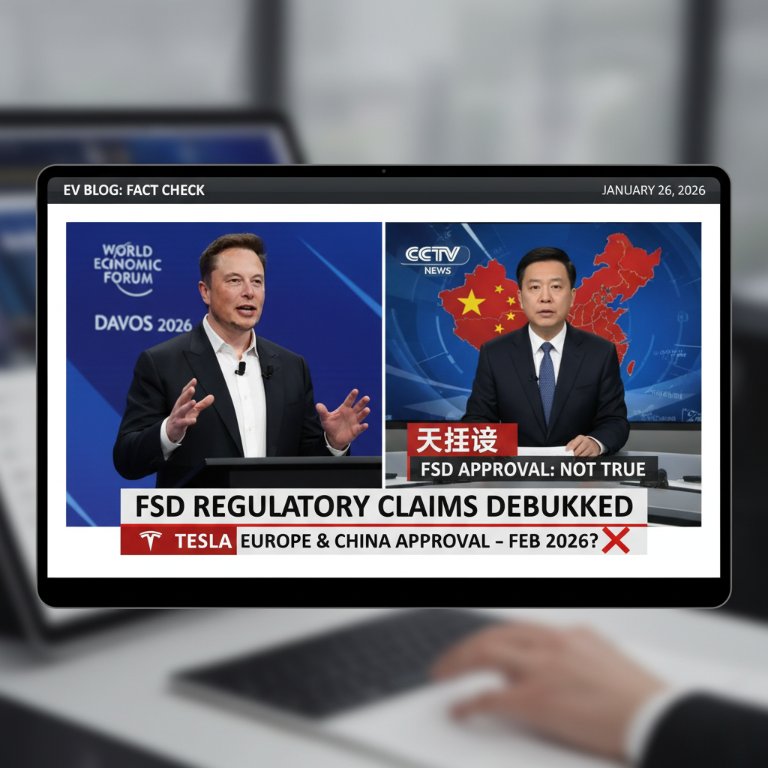
In a development that underscores the complex global regulatory landscape for autonomous driving, Tesla CEO Elon Musk's ambitious timeline for Full Self-Driving (FSD) system approval in Europe and China has hit an immediate snag. Speaking at the prestigious World Economic Forum in Davos, Musk confidently projected regulatory clearance for Tesla's driver-supervised FSD as early as February 2026. However, this optimistic outlook was swiftly challenged, particularly from Beijing, casting a shadow over Tesla's aggressive global deployment strategy.
For years, Tesla has been at the forefront of pushing the boundaries of automotive autonomy with its Full Self-Driving system. While marketed as 'Full Self-Driving,' the system remains a Level 2 driver-assist feature, requiring constant driver supervision and readiness to intervene. This nuanced distinction, coupled with ongoing scrutiny over safety and functionality, has meant a protracted and often challenging path to regulatory acceptance across different jurisdictions. The current news isn't just about a timeline; it's a stark reminder that even a titan like Tesla must navigate a labyrinth of national regulations and geopolitical considerations, often proving more formidable than technical hurdles.
Musk's Bold Davos Projections
Elon Musk, known for his audacious predictions, used the high-profile platform of the World Economic Forum to announce his expectation of imminent FSD regulatory approval. Specifically, Musk stated that Tesla anticipates receiving the green light for its driver-supervised FSD system in both Europe and China by February 2026. This pronouncement signaled an accelerated push into key international markets, critical for the wider adoption and profitability of Tesla's advanced driver-assistance technologies.
China's Swift Rebuttal
Musk's optimism, however, was quickly tempered. Later on the very same day as his Davos announcement, Chinese state media, citing highly reliable sources, unequivocally refuted the claim regarding FSD approval for next month. The authoritative statement from China indicated that such an approval timeline is 'not true' and simply 'does not align with the current regulatory timeline.' This immediate and direct contradiction from a major market highlights the significant disconnect between Tesla's internal expectations and the external realities of navigating sovereign regulatory bodies. It suggests a lack of synchronized understanding or perhaps an overestimation of the speed at which complex autonomous driving regulations are processed in China.
Europe's Deliberate Regulatory Path
The situation in Europe, while less confrontational, also points to a cautious and methodical approach. The Dutch vehicle authority RDW, a key player in European vehicle type approval, had previously indicated that a decision on FSD for Europe was expected in February. This suggests that while European authorities are indeed reviewing the system, the process is thorough and not necessarily a rubber stamp. Europe's regulatory framework for advanced driver-assistance systems is complex, often requiring harmonization across member states and strict adherence to safety protocols set by bodies like the UNECE. A 'decision' in February does not automatically equate to immediate widespread deployment across the continent, as local implementations and further testing may still be required.
Why This Matters:
This immediate pushback, particularly from China, represents more than just a scheduling conflict; it's a significant blow to Tesla's credibility and its strategic global FSD rollout. Here's why this matters:
- Credibility Under Scrutiny: Musk's highly public and optimistic pronouncements, followed by swift refutations from national authorities, can erode trust among regulators, investors, and the public. It raises questions about the accuracy of internal information and Tesla's communication strategy with key markets.
- Market Signal to Competitors: The incident signals that global FSD deployment is not a unilateral move for Tesla. Competitors working on their own autonomous solutions, such as Waymo, Cruise (despite recent setbacks), and traditional automakers like Mercedes-Benz (with their Level 3 Drive Pilot), can take note of the regulatory hurdles. This might encourage more cautious, region-specific approaches rather than broad, optimistic timelines.
- Impact on Revenue and Valuation: FSD is a critical potential revenue stream for Tesla, both through upfront sales and subscription services. Delays in key markets like China, the world's largest automotive market, directly impact the company's financial projections and, by extension, its valuation. Investors closely watch these milestones as indicators of future growth.
- Regulatory Independence: The firm rejection from China underscores the independence and authority of national regulatory bodies. It serves as a powerful reminder that even the most innovative companies must operate within established legal and governmental frameworks, which prioritize safety and national interests over corporate timelines.
- The Future of Global Autonomous Driving: This saga highlights the inherent difficulty in achieving universal regulatory approval for complex autonomous driving systems. Divergent national standards, differing liability laws, and varied public acceptance levels mean that a truly 'global' FSD deployment might be a fragmented, region-by-region process, rather than a simultaneous launch.
The immediate future will see Tesla needing to recalibrate its expectations and communication regarding FSD's international availability. While the RDW's February decision for Europe remains to be seen, the clear rejection from China forces a re-evaluation of Tesla's aggressive global ambitions. The path to true full self-driving, even supervised, remains paved with significant regulatory and geopolitical challenges that even Elon Musk's considerable influence cannot simply overcome with a pronouncement.