Musk's AI Reset: xAI 'Rebuilt From Foundations Up' As Tesla's Robotaxi Ambitions Retreat
Elon Musk's ambitious artificial intelligence venture, xAI, is undergoing a profound foundational overhaul, a stark admission by Musk himself that the...
Editorial Team
World Of EV
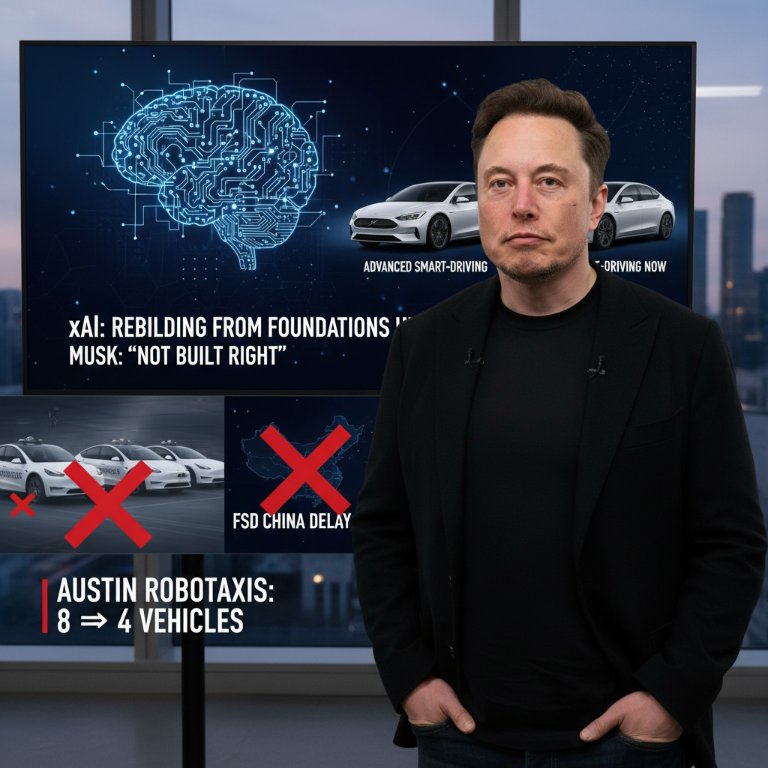
Elon Musk's ambitious artificial intelligence venture, xAI, is undergoing a profound foundational overhaul, a stark admission by Musk himself that the company 'was not built right first time around.' This revelation comes mere weeks after Tesla injected a substantial $2 billion into the fledgling AI firm, raising critical questions about the return on investment and the strategic direction of Musk's intertwined AI empire. This internal reconstruction at xAI runs parallel to alarming reports from the front lines of Tesla's Full Self-Driving (FSD) development, where the unsupervised robotaxi fleet in Austin, Texas, has reportedly been halved from eight to just four vehicles. This reduction follows a troubling pattern of FSD failures and higher crash rates, casting a long shadow over Tesla's long-promised autonomous future.
xAI's Foundational Reset: A $2 Billion Gamble Reworked
Musk's declaration that xAI is being 'rebuilt from the foundations up' is more than just a candid remark; it's an acknowledgement of significant internal challenges within a company touted as a rival to OpenAI and Google DeepMind. For context, xAI's formation in July 2023 was pitched as a quest to 'understand the true nature of the universe,' with a direct link to Tesla through shared talent and, now, substantial capital. Tesla's recent $2 billion investment underscores the strategic importance Musk places on xAI's success, particularly for its potential synergy with Tesla's own AI-driven autonomous driving efforts. However, a ground-up rebuild suggests that the initial architectural decisions or foundational research at xAI fell short of expectations, indicating a potentially costly and time-consuming reset for a company operating in a fiercely competitive and rapidly evolving field.
Robotaxi Roadblocks: Austin's Fleet Halved Amid Performance Concerns
While xAI grapples with its internal restructuring, Tesla's immediate autonomous driving aspirations are facing tangible setbacks. The reported reduction of the unsupervised robotaxi fleet in Austin, Texas, from eight to four vehicles is a concerning development for a company that has long promised a future dominated by revenue-generating robotaxis. This downsizing isn't an isolated incident; it follows previous reports detailing FSD failures and an elevated crash rate, eroding public confidence and fueling skepticism among industry analysts. These issues are particularly salient given Musk's aggressive timelines, including his 2020 prediction of one million robotaxis on the road, a target that remains elusive as FSD continues its protracted 'beta' phase. The practical challenges in Austin highlight the immense hurdles still facing truly unsupervised Level 4 or Level 5 autonomous driving.
China's Smart-Driving Race: Tesla Stumbles While Local Rivals Advance
Compounding Tesla's autonomous woes is the continued delay of its Full Self-Driving entry into the lucrative Chinese market. This delay is especially problematic in a region where local automakers are not just catching up but actively pulling ahead, delivering advanced smart-driving vehicles to consumers at an accelerating pace. Companies like Xpeng, Nio, and Huawei-backed AITO are deploying sophisticated navigation-on-autopilot systems and urban autonomous features that are already in the hands of customers, showcasing capabilities that Tesla is still struggling to roll out globally. The competitive landscape in China underscores Tesla's diminishing lead in autonomous technology, once considered a cornerstone of its innovation.
Why This Matters:
This confluence of events signals a critical juncture for Tesla's AI and autonomous driving ambitions. The rebuild of xAI, especially after a massive $2 billion investment from Tesla, is not merely an internal corporate restructuring; it suggests fundamental challenges in developing cutting-edge AI. For investors, this raises questions about capital allocation and the timeline for tangible returns from AI ventures. A delayed or problematic xAI could directly impact the advancement of Tesla's FSD capabilities, which rely heavily on sophisticated AI models for perception, prediction, and control.
The robotaxi fleet reduction in Austin, coupled with ongoing FSD performance issues, directly impacts consumer trust and the long-term viability of Tesla's 'robotaxi network' vision. Every reported failure or crash erodes the public's willingness to embrace autonomous vehicles, and the slow pace of development allows competitors to innovate and refine their own solutions. This is a "do-or-die" moment for Tesla's autonomy aspirations; continued setbacks could push their timeline for true full self-driving further into the future, potentially ceding market leadership to more agile or fundamentally sound competitors.
In the grand scheme, the biggest winners from Tesla's current struggles appear to be the rapidly advancing local Chinese automakers. Their ability to deploy advanced smart-driving features now, while Tesla struggles with delays and performance, positions them favorably in the world's largest and most competitive EV market. This signals a potential shift in global autonomous driving leadership, challenging Tesla's historical dominance and forcing a reevaluation of who truly holds the technological edge.
Tesla’s dual challenges – rebuilding its core AI venture and confronting the practical limitations of its FSD rollout – paint a picture of significant headwinds for the company’s ambitious autonomous future. While Musk remains a visionary, the execution of these complex technologies requires foundational robustness, and the current signals suggest a painful recalibration rather than seamless progress. The coming years will reveal whether these resets pave the way for a stronger future or if they are symptomatic of deeper, systemic issues that could ultimately redefine Tesla’s position in the autonomous driving race.