Musk's AGI Dreams Clash with Tesla's Plummeting 2025 Sales Reality
Elon Musk's recent assertion that Tesla will 'probably' be the first to achieve Artificial General Intelligence (AGI) in 'humanoid/atom-shaping form' ...
Editorial Team
World Of EV
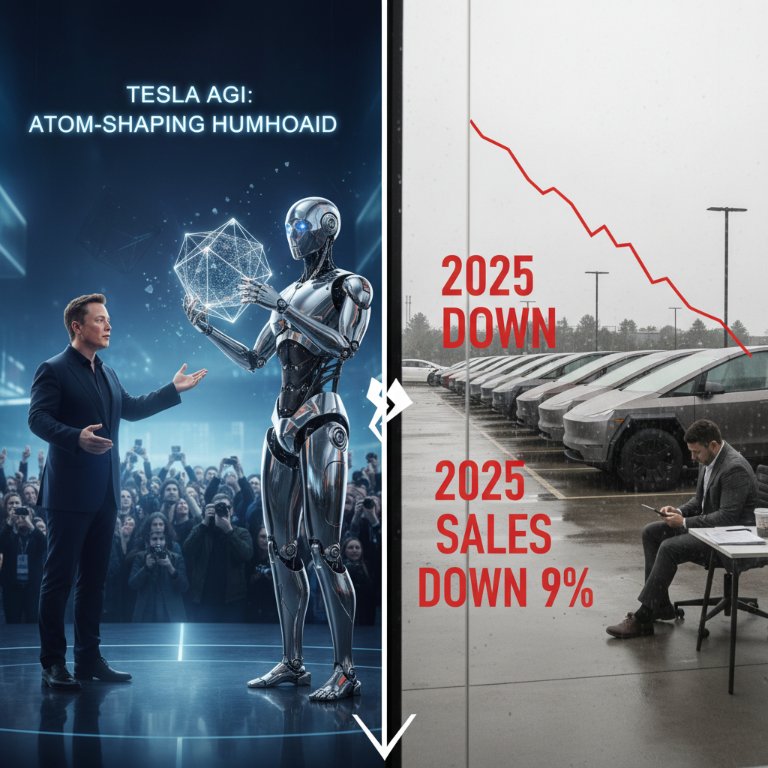
Elon Musk's recent assertion that Tesla will 'probably' be the first to achieve Artificial General Intelligence (AGI) in 'humanoid/atom-shaping form' through its Optimus robot has once again captured headlines. This bold claim, however, arrives at a moment of unprecedented challenge for the automotive giant, as its 2025 financial performance reveals a stark contrast between futuristic ambition and immediate market realities.
For an audience of savvy EV enthusiasts and industry professionals, Musk's pronouncements often ignite both excitement and skepticism. While the vision of AGI through Optimus paints a picture of transformative technological leadership, it also stands in sharp relief against the company's first-ever annual decline in vehicle sales and revenue, signaling a pivotal moment for the industry's erstwhile disruptor.
Musk's AGI Gambit and the Optimus Vision
Musk's declaration that Tesla is on the cusp of AGI, specifically through its Optimus humanoid robot, is characteristic of his expansive technological outlook. The idea of AGI, a theoretical AI capable of understanding, learning, and applying its intelligence to a wide range of problems, has profound implications. Integrating this into a physical form, as proposed with Optimus, suggests a future where Tesla's influence extends far beyond mere transportation.
However, this isn't the first time Tesla, under Musk's leadership, has made ambitious claims regarding AI and autonomous capabilities. The journey of Full Self-Driving (FSD) has been marked by numerous revised timelines and evolving capabilities, often leading to a gap between promised functionality and real-world deployment. This history creates a crucial context for evaluating the AGI claim, urging caution even as the potential remains fascinating.
Tesla's 2025 Performance: A Stark Reality Check
While Musk articulates a future defined by AGI, Tesla's 2025 business performance paints a considerably different picture. The company experienced a significant downturn, marking its first annual decline in key financial metrics:
- Vehicle Sales: A 9% year-over-year decrease to 1.63 million units.
- Revenue: A 3% reduction in full-year revenue, landing at approximately $94.8 billion.
This contraction comes amidst intensified competition in the global EV market. What was once a largely uncontested playing field for Tesla is now saturated with formidable rivals, ranging from established automotive giants like Volkswagen and GM to aggressive new entrants like BYD, all vying for market share with compelling new models and rapidly evolving battery technology. The decline suggests that Tesla's aging product lineup and fluctuating pricing strategies struggled to maintain momentum against a backdrop of increasing consumer choice and macroeconomic pressures.
Why This Matters:
For Tesla's Vision: The declining sales figures raise critical questions about the company's immediate strategic focus. Is the emphasis on AGI and Optimus a long-term play that investors are still willing to fund amidst core business struggles, or does it risk becoming a distraction from the urgent need to rejuvenate its automotive offerings? This signals a pivotal moment for Tesla to demonstrate how its long-term AI bets will directly translate into tangible benefits for its core products and financial health.
For the EV Market: Tesla's struggle underscores the maturation of the EV industry. Its declining market share is a clear win for competitors, who are now demonstrating their ability to innovate and scale. This intense competition ultimately benefits consumers through greater choice, more advanced features, and potentially more aggressive pricing across the board.
For EV Buyers: While AGI remains a distant promise, the immediate impact for buyers is likely to be a more competitive and dynamic market. Tesla's challenges could prompt a renewed focus on automotive fundamentals—range, charging infrastructure, interior quality, and price—to win back market share, potentially accelerating innovation and value propositions from all manufacturers.
Conclusion:
Tesla finds itself at a critical crossroads, balancing the allure of groundbreaking AI with the imperative of a robust automotive business. While Elon Musk's AGI aspirations continue to push the boundaries of technological imagination, the reality of declining 2025 sales demands an equally innovative and decisive strategy for its core EV offerings. The coming years will reveal whether Tesla can successfully bridge this gap, translating its futuristic visions into sustained market leadership amidst an increasingly competitive landscape.