Musk Issues Stark Warning: Gigafactory Berlin Expansion Hinges on Works Council Election Outcome
GRÜNHEIDE, GERMANY – In a dramatic escalation of labor tensions, Elon Musk delivered a pre-recorded video message to the 10,700 employees at Tesla's G...
Editorial Team
World Of EV
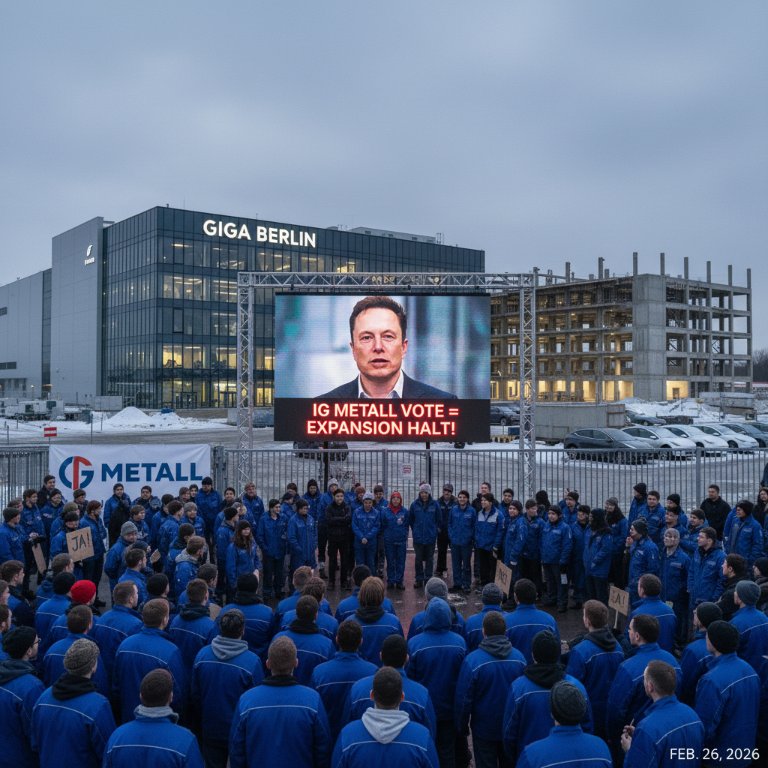
GRÜNHEIDE, GERMANY – In a dramatic escalation of labor tensions, Elon Musk delivered a pre-recorded video message to the 10,700 employees at Tesla's Gigafactory Berlin-Brandenburg, explicitly warning that the plant's crucial expansion plans will be halted if the powerful IG Metall union gains significant influence in the upcoming works council election. This direct threat, delivered mere days before the critical vote, plunges Tesla into a deeper conflict with Germany's most influential industrial union, all while the automaker grapples with a steep decline in its European sales.
Musk's Ultimatum: Expansion at Risk
Musk's message, conveyed from Austin, Texas, alongside Gigafactory Berlin plant manager André Thierig, left no room for ambiguity. He cautioned that "things will certainly get more difficult if there are external organizations pushing Tesla in the wrong direction," making it clear that while the factory would not close, expansion would realistically not proceed under such circumstances. This warning comes as Gigafactory Berlin, currently capable of producing over 375,000 Model Ys annually, had already received initial approvals for expanding its footprint and was planning a significant ramp-up, including the start of battery cell production by 2027. Tesla aims to eventually increase Model Y production to 500,000 and even 1 million vehicles per year at the site, which is its only manufacturing base in Europe.
The German Labor Landscape and Tesla's Clash
Tesla's stance directly challenges Germany's deeply ingrained system of co-determination. IG Metall is Germany's largest and most powerful industrial union, a formidable force in the nation's manufacturing sector. Works councils, distinct from unions but often influenced by them, are legally mandated employee representative bodies in companies with more than five employees. They wield extensive rights to information, consultation, and even co-determination on matters ranging from working conditions and schedules to personnel measures and new technologies. Ignoring a works council is ill-advised and can lead to significant sanctions for employers.
Tesla, historically a staunch opponent of unionization across its global operations, has faced numerous allegations of anti-union tactics in the U.S. and is currently embroiled in an ongoing strike with IF Metall in Sweden. The conflict at Gigafactory Berlin has been escalating for months, including accusations of secret recordings during works council meetings and defamation complaints filed by both Tesla and IG Metall, though a temporary settlement on these specific issues has been reached ahead of the election.
Headwinds in a Competitive European Market
The ultimatum also lands amidst a challenging period for Tesla in Europe. In 2025, the company's total vehicle sales in Europe declined sharply by 28%. This downward trend has continued into early 2026, with January registrations plunging 17% while the broader European EV market actually grew by 13.9%. Analysts attribute this struggle to several factors:
- Intensifying Competition: A flood of new, often more affordable, EV models from established European brands and rapidly expanding Chinese manufacturers like BYD is eroding Tesla's once-dominant market share.
- Aging Product Portfolio: Despite a refreshed Model Y, Tesla has been slow to introduce truly new, budget-friendly models that can compete in a diversifying market.
- CEO Persona: Elon Musk's controversial public statements have also been cited as a factor alienating some European consumers.
Why This Matters:
- Strategic Gambit or Sincere Threat? This could be interpreted as a high-stakes strategic play by Musk to exert control over the German workforce, testing the limits of Germany's robust co-determination laws. However, with European sales in decline and Gigafactory Berlin already operating below its maximum potential capacity, one might question the immediate necessity of further expansion. Is this a genuine business consequence or a powerful lever to influence the election outcome?
- Clash of Corporate Cultures: The conflict highlights the fundamental incompatibility between Tesla's historically anti-union, top-down management style and the collaborative, co-determination model deeply embedded in German industrial culture. A strong works council, particularly one influenced by IG Metall, would demand a level of employee involvement and negotiation that Tesla has consistently resisted.
- Impact on European Growth: A delay or cancellation of expansion at Gigafactory Berlin would severely hamper Tesla's ability to localize production, potentially raising costs and making it even harder to compete with European and Chinese rivals who are rapidly expanding their footprints and tailoring vehicles for the regional market. This decision could further cede market share in a critical region.
- Worker Empowerment vs. Corporate Autonomy: For the workers, the election is a choice between potentially greater protection, better working conditions, and a stronger voice through union-backed representation, versus the risk of jeopardizing future investment and job growth. For Tesla, it's about maintaining operational flexibility and control.
Conclusion:
The works council election at Gigafactory Berlin is far more than an internal HR matter; it is a battleground defining the future of labor relations in the EV industry and a crucial test for Tesla's long-term strategy in Europe. The outcome will not only determine the trajectory of one of the continent's most significant EV manufacturing hubs but also send a powerful signal across global automotive production floors regarding the balance between corporate ambition and employee rights.