Mazda CX-90 PHEV's Icy Reality: Real-World Range Halves in Cold, Challenging Daily Utility
Mazda's electrification strategy faces a significant hurdle as real-world testing of the 2026 CX-90 PHEV GT reveals a concerning nearly 50% drop in el...
Editorial Team
World Of EV
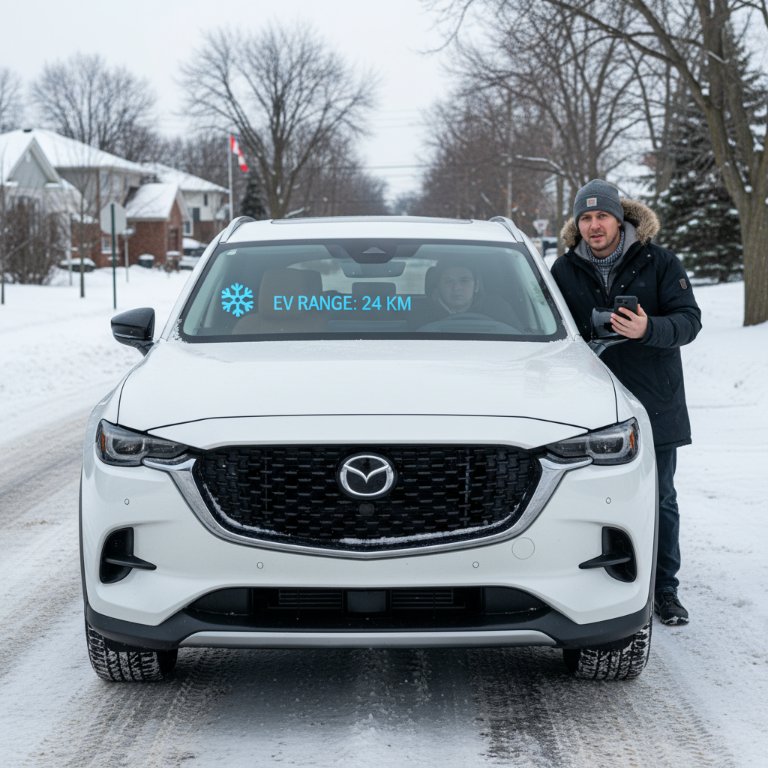
Mazda's electrification strategy faces a significant hurdle as real-world testing of the 2026 CX-90 PHEV GT reveals a concerning nearly 50% drop in electric range under cold Canadian conditions. This discrepancy, compared to the official 42-kilometer rating, dramatically limits the vehicle's daily usability and threatens its value proposition for prospective owners.
After years of relying on adapted platforms and making cautious forays into electrification, exemplified by the somewhat compromised MX-30 EV with its limited range, the CX-90 PHEV was intended to signal Mazda's serious commitment to the plug-in hybrid segment. It promised a blend of Mazda's signature driving dynamics with practical electric capability, but these latest findings suggest the promise may not hold up when the mercury drops.
The Promise Versus the Frosty Reality
The official manufacturer’s estimate for the 2026 Mazda CX-90 PHEV GT's electric range stands at a respectable 42 kilometers, a figure that suggests many drivers could handle their daily commutes solely on electric power. However, a recent review conducted on a cold morning paints a starkly different picture. The EV range display initially showed approximately 30 kilometers, but this quickly plummeted to just 24 kilometers after a brief drive. This real-world performance represents a nearly 50% reduction from the advertised range, a figure that is far more than a minor deviation.
This isn't just a minor inconvenience; it fundamentally alters the CX-90 PHEV's utility. For a vehicle marketed to bridge the gap between pure internal combustion and full electrification, losing half its promised electric capability in common winter conditions undermines its core purpose. The expectation of using solely electric power for short trips or daily errands evaporates, pushing drivers to rely on the gasoline engine much sooner than anticipated.
Understanding the Discrepancy
The phenomenon of reduced battery performance in cold weather is well-documented across the EV industry. Lithium-ion batteries are less efficient in lower temperatures, affecting both charging speeds and available range. Moreover, the energy demands of cabin heating, seat heaters, and other auxiliary systems are significantly higher in cold conditions, further depleting the battery more rapidly than in temperate climates. While some range reduction is expected, a nearly 50% decrease points to potential issues with either the battery's thermal management system, the calibration of the range estimator, or perhaps an overly optimistic official rating that doesn't adequately account for real-world cold-weather driving profiles.
Why This Matters:
This revelation about the CX-90 PHEV's cold-weather range is a critical blow to Mazda's electrification efforts, especially for consumers in markets with distinct winter seasons. For the savvy EV enthusiast and prospective buyer, a PHEV with a real-world electric range of barely 20-25 kilometers transforms from a viable daily EV commuter into little more than a hybrid with a larger, heavier battery pack. The primary value proposition of a PHEV—the ability to perform significant driving on electric power—is severely diminished. This directly impacts the total cost of ownership, fuel savings, and the environmental benefits drivers expect.
Who Wins? Competitors like the Toyota RAV4 Prime or Hyundai Santa Fe PHEV, which often demonstrate more robust cold-weather performance or offer a larger buffer of initial range, stand to gain. These established players have either refined their battery management systems or simply provided larger capacities that can better withstand cold-induced degradation. Consumers in warmer climates might still find the CX-90 appealing, but those in colder regions will likely look elsewhere.
Who Loses? Mazda unequivocally loses. This issue tarnishes the CX-90 PHEV’s reputation and calls into question the brand’s overall competency in developing competitive electrified powertrains. It signals to the market that Mazda’s “multi-solution” approach to electrification, while offering flexibility, may be lagging in delivering truly competitive EV performance. This could be a significant setback in an increasingly crowded and competitive electrified vehicle market, hindering sales and potentially forcing Mazda to re-evaluate its thermal management strategies or battery sizing for future PHEV offerings.
This early performance review of the 2026 Mazda CX-90 PHEV GT delivers a sobering message: official range figures often represent ideal conditions, and real-world performance, particularly in challenging climates, can diverge significantly. For Mazda, a brand still striving to firmly establish its electric credentials, this substantial range reduction in cold weather is a critical issue that must be addressed swiftly to maintain consumer trust and remain relevant in the accelerating shift towards electrification.