Maximize Your EV's Lifespan: The Critical '20-80 Rule' and Why Cable Safety Isn't Optional
For dedicated EV enthusiasts and prospective buyers navigating the electric revolution, battery health and charging safety remain paramount concerns. ...
Editorial Team
World Of EV
For dedicated EV enthusiasts and prospective buyers navigating the electric revolution, battery health and charging safety remain paramount concerns. While modern electric vehicles boast sophisticated battery management systems (BMS) and robust charging technologies, owner habits continue to play a surprisingly significant role in determining an EV's longevity and operational safety. Neglecting simple best practices can lead to premature battery degradation and, in worst-case scenarios, serious hazards.
Beyond simply plugging in, understanding the nuances of EV charging is crucial. Just as a performance internal combustion engine requires specific fuel and maintenance, your EV's advanced lithium-ion battery thrives under optimal conditions that prevent undue stress and wear. This isn't just about extending range; it's about preserving a significant investment and ensuring peace of mind for years to come.
The '20% to 80% Rule': Your Battery's Sweet Spot
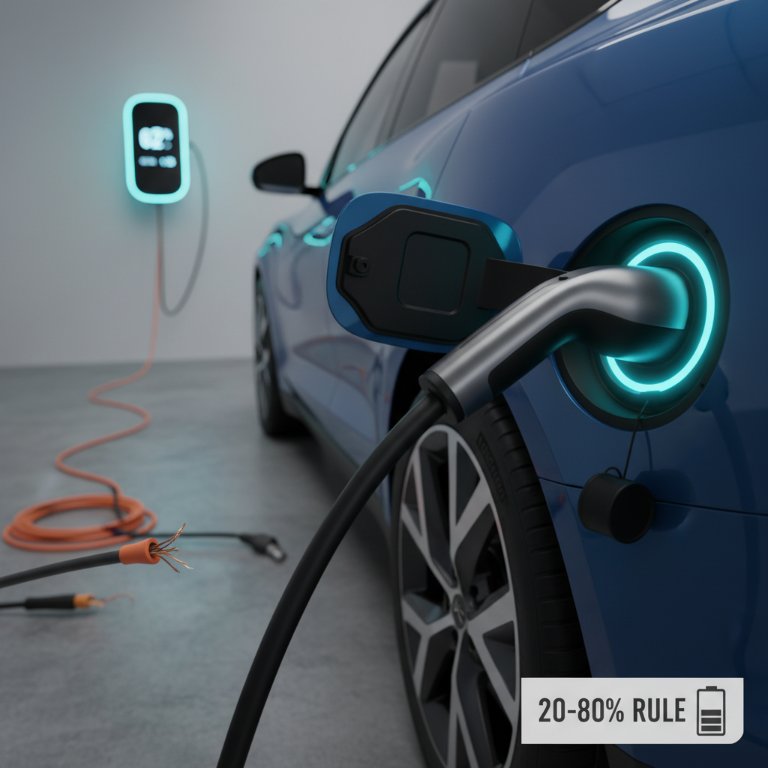
One of the most widely recommended and effective strategies for preserving EV battery health is adhering to the '20% to 80% rule' for daily charging. This principle suggests keeping your EV's state of charge (SoC) within this optimal range, avoiding consistent charges to 100% or discharges below 20%.
- Why it works: Lithium-ion batteries experience increased stress and heat generation when pushed to their extreme charge limits (both full and near-empty). Staying within the 20-80% zone reduces this voltage stress, slows chemical degradation, and helps maintain the integrity of the battery's electrodes.
- Faster Charging: Counterintuitively, the final 20% of a battery's charge (from 80% to 100%) often takes as long, or even longer, than charging from 20% to 80%. This is because the car's Battery Management System (BMS) intelligently slows down charging speeds to protect the battery as it nears full capacity, especially during DC fast charging.
- Practical Application: Many EVs allow owners to set a charge limit in their vehicle or through a mobile app. Setting this to 80% for daily use automates this battery-friendly habit. For long trips where maximum range is essential, an occasional 100% charge is acceptable, but it should not be a regular practice.
Recent data from Geotab's updated EV battery health study indicates an average annual degradation rate of 2.3%, a slight increase from previous findings, which they attribute to a growing reliance on high-power DC fast charging. Vehicles heavily utilizing DC fast charging above 100 kW experienced degradation at roughly double the rate (up to 3% per year) compared to those primarily using AC or lower-power charging.
Non-Negotiable Safety: Damaged Charging Cables
Beyond optimizing battery life, immediate replacement of damaged charging cables is a critical safety imperative. This isn't merely about inconvenience or reduced charging efficiency; it's about preventing severe electrical shock and fire hazards.
- The Dangers: A compromised cable, with visible cuts, frayed wires, or even internal damage, can expose live wires, leading to electrical shorts and overheating. This surge of electricity can damage the charging station's components, your EV's charging system, and in the worst case, ignite a fire.
- Warranty Implications: Using damaged or non-compliant charging equipment can also void your EV's warranty, leaving owners responsible for potentially expensive repairs to their vehicle's charging system.
- Prevention: Regularly inspect your charging cable for any signs of wear and tear. Always handle the cable with care, avoid driving over it, and ensure it's properly coiled and stored when not in use.
Why This Matters:
This isn't merely a set of recommendations; it's a foundational understanding for every EV owner and a critical signal for the industry. For owners, embracing these best practices directly translates to a healthier, longer-lasting, and safer vehicle. A well-maintained EV battery retains more of its capacity over time, enhancing resale value and extending the usable life of the vehicle—an increasingly important factor as EV adoption accelerates. The average EV battery is already projected to last 15-20 years, often exceeding the lifespan of an ICE vehicle, but owner habits can significantly influence whether you reach the higher end of that spectrum.
For the industry, these guidelines underscore the ongoing need for robust Battery Management Systems (BMS) that actively mitigate user errors and optimize charging profiles. BMS units already monitor and control battery state, preventing overcharging and excessive discharging, but enhanced user education and intuitive vehicle software that guides owners toward optimal charging will be increasingly vital. This emphasis on user responsibility also signals a maturing EV market, where the focus shifts from raw performance specs to sustainable, reliable, and safe ownership experiences. Who wins? Savvy consumers who protect their investment, and manufacturers who build vehicles with resilient, well-managed battery systems. Who loses? Those who disregard these simple rules, risking premature battery degradation, reduced range, and potentially costly safety incidents. This is a call to action for every EV driver to become an active participant in their vehicle's long-term health.
The future of EV ownership is bright, characterized by increasingly efficient batteries and advanced charging infrastructure. However, the ultimate health and safety of your electric vehicle will always remain a shared responsibility between cutting-edge technology and conscientious owner practices. By adopting smart charging habits and prioritizing cable integrity, EV drivers can confidently unlock the full potential and extended lifespan of their electric investment.