Lucid Accelerates Transformation: Strategic Cuts Pave Way for Mainstream EV Push
Lucid Motors, long heralded as a disruptor in the luxury EV space, is undergoing a pivotal transformation. While its latest financial report boasts a ...
Editorial Team
World Of EV
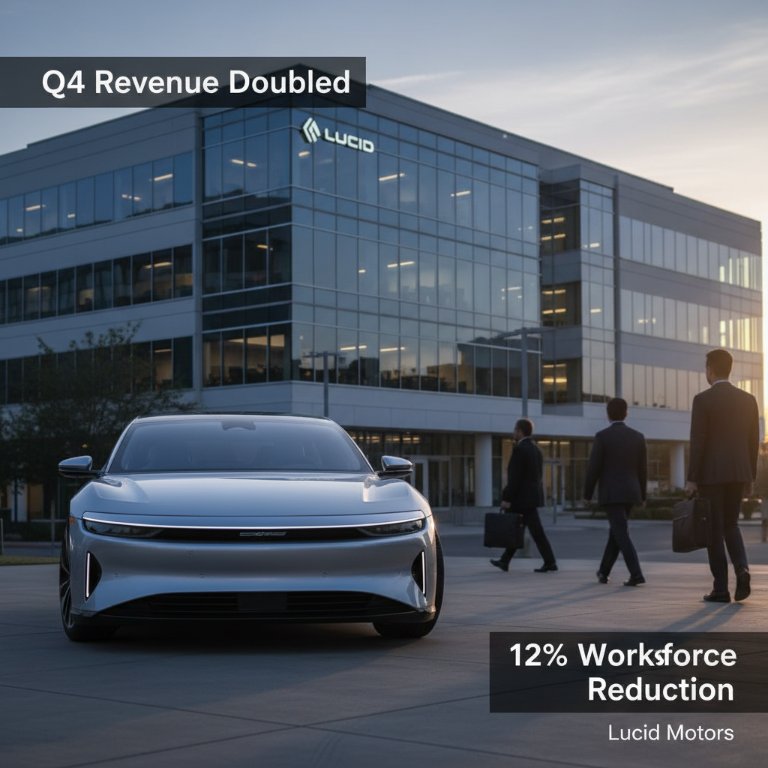
Lucid Motors, long heralded as a disruptor in the luxury EV space, is undergoing a pivotal transformation. While its latest financial report boasts a more than doubling of revenue for the fourth quarter of 2025, the company continues to battle significant losses. This dual reality—impressive growth juxtaposed with persistent unprofitability—underscores the intense pressure on EV startups to scale efficiently. Fresh off the highly anticipated launch of its Gravity SUV, Lucid is now implementing a strategic 12% workforce reduction across its U.S. non-production staff, a bold move aimed at streamlining operations and fueling its ambitious expansion into more accessible price points.
Revenue Surges Amid Lingering Losses
Lucid’s Q4 2025 performance saw sales revenue surge, a clear indicator of growing market acceptance for its critically acclaimed Lucid Air sedan and the initial traction of the new Gravity SUV. This revenue growth, doubling year-over-year, is a vital sign for a company that has, for years, faced skepticism regarding its ability to convert its technological prowess into commercial success. However, the persistent net losses remain a dark cloud over this otherwise positive financial update. Building a new automotive brand from the ground up, especially in the capital-intensive EV sector, demands immense investment, and Lucid is clearly still in this crucial, cash-burning phase.
Strategic Workforce Reduction and Cost Savings
To navigate this delicate balance of growth and expenditure, Lucid is executing a significant realignment of its resources. Approximately 12% of its U.S. workforce, specifically targeting non-hourly production staff, will be impacted by recent layoffs. This isn't merely a cost-cutting exercise; it's a strategic reallocation post-Gravity launch. The company anticipates these measures will generate a substantial $500 million in cost savings over the next three years, funds that can be reinvested into critical areas like research and development for future models, expanding production capabilities, or shoring up its charging infrastructure efforts. This move suggests a maturation in Lucid's operational strategy, shifting from pure expansion to a more disciplined, efficiency-driven approach.
Ambitious Production Targets and a Mainstream Pivot
Looking ahead to 2026, Lucid has set a production target of between 25,000 and 27,000 vehicles. While an increase, it remains a conservative estimate compared to some legacy automakers' EV ambitions, reflecting perhaps a realistic assessment of current market demand and manufacturing ramp-up challenges. Crucially, the company is also signaling a major shift in its product strategy with the planned introduction of a cheaper midsize crossover, priced around $50,000, by the end of 2026. This pivot towards a more accessible price point, a significant departure from the ultra-luxury Air and Gravity, indicates Lucid's intent to broaden its appeal and capture a larger slice of the burgeoning mainstream EV market.
Why This Matters:
- Financial Discipline Meets Market Reality: The simultaneous report of doubling revenue and continued losses highlights the brutal economics of launching an EV company. The 12% workforce reduction, while painful, is a necessary pivot. It signals Lucid's commitment to financial discipline, demonstrating to investors that it's actively addressing its cash burn rather than solely relying on its technological superiority. This move is less about immediate distress and and more about long-term sustainability, akin to how other nascent automakers have rationalized operations after initial launches.
- The Gravity Effect and Product Diversification: The Gravity SUV's launch and the subsequent resource reallocation are key. The SUV is crucial for Lucid to diversify its revenue streams beyond the Air sedan, which, while lauded, operates in a niche segment. The announcement of a $50,000 midsize crossover by late 2026 is arguably the most significant strategic shift. This vehicle places Lucid directly into the competitive, high-volume segment currently dominated by models like the Tesla Model Y and Ford Mustang Mach-E. This is a "do-or-die" moment for Lucid; success here could unlock exponential growth and finally lead to profitability, but failure could see them relegated to a perpetual niche player.
- Shifting Market Dynamics: Lucid's push into a lower price point acknowledges the broader EV market trend. While luxury EVs retain their allure, the overall demand growth is increasingly driven by more affordable, practical options. This strategy pits Lucid against established giants and agile newcomers, demanding not just superior technology, but also efficient manufacturing, competitive pricing, and robust service networks. If Lucid can deliver its signature luxury and performance at a $50,000 price point, it could be a game-changer; if not, it risks diluting its brand without achieving significant volume.
- Investor Confidence and Future Outlook: For savvy EV enthusiasts and prospective buyers, these changes are critical. A more financially stable Lucid means better long-term support, continued innovation, and a broader product portfolio. For industry professionals, it's a clear signal that even the most well-funded EV startups must prioritize operational efficiency and market diversification to survive and thrive in a rapidly evolving, and increasingly competitive, landscape.
Lucid Motors is undeniably at a crossroads. Its increased revenue demonstrates continued product appeal, but persistent losses demand decisive action. The strategic workforce reduction and the clear intent to enter the mainstream EV market with a $50,000 crossover by late 2026 are bold, necessary steps. The coming years will determine whether Lucid can successfully transition from an aspirational luxury brand to a significant player across multiple EV segments, finally converting its technological brilliance into sustainable profitability.