Ingenious E-Bike Mod Unlocks Public Car Chargers, Paving Way for Broader EV Infrastructure Utility
A groundbreaking 'life hack' by individual innovator Matt Gray is set to revolutionize how electric bicycle users perceive range and charging accessib...
Editorial Team
World Of EV
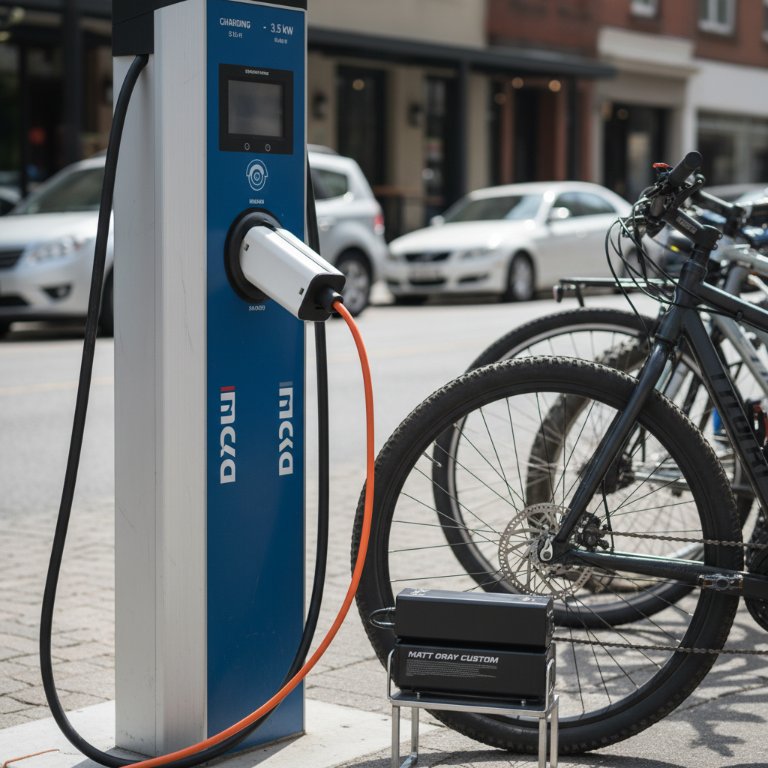
A groundbreaking 'life hack' by individual innovator Matt Gray is set to revolutionize how electric bicycle users perceive range and charging accessibility. Gray has ingeniously designed a custom housing that integrates a standard e-bike battery charger with a conventional car charging socket, effectively allowing e-bikes to tap into the vast network of lower-powered public car charging stations. This innovation doesn't just extend an e-bike's range; it fundamentally reimagines the utility of existing EV infrastructure, signaling a significant shift in personal electric mobility.
For years, e-bike riders have contended with proprietary charging solutions, limiting their ability to recharge on the go and often tethering them to home outlets or specific e-bike charging points. While the EV charging landscape for cars has rapidly expanded, a similar public infrastructure for light electric vehicles like e-bikes has lagged, leaving a significant gap for commuters and enthusiasts alike. Gray's solution directly addresses this disparity, demonstrating a practical bridge between two distinct yet increasingly interconnected segments of the electric vehicle market.
The Ingenious Solution: A DIY Bridge to Broader Charging
Matt Gray's approach is remarkably straightforward yet profoundly impactful. His custom-designed adapter acts as a conduit, housing the e-bike's existing charger within a shell that interfaces with a standard car charging port. This clever integration allows him to draw power from public car charging stations, primarily utilizing the more common Level 2 (AC) chargers, which deliver lower power suitable for an e-bike battery without overloading or compatibility issues. This setup offers several critical advantages:
- Unprecedented Range Extension: E-bike riders can now confidently plan longer journeys, knowing that public car charging stations can serve as viable recharge points, mitigating 'range anxiety.'
- Enhanced Convenience: Access to charging points is dramatically increased, particularly in urban and suburban areas where car chargers are becoming ubiquitous.
- Cost-Effective Charging: Many public Level 2 chargers offer competitive rates, making on-the-go charging more economical than some dedicated solutions.
- Proof of Concept: Gray's innovation serves as a tangible demonstration that existing infrastructure can be repurposed and leveraged for a broader spectrum of electric vehicles.
Why This Matters:
Matt Gray's 'life hack' transcends a mere technical workaround; it’s a powerful market signal and a testament to user-driven innovation. This development carries significant implications for various stakeholders:
- Winners: E-bike users are the immediate beneficiaries, gaining unparalleled freedom and extended range. Charge point operators could also see increased utilization of their lower-powered chargers, turning previously underutilized assets into revenue streams. Furthermore, this opens a new market for accessory manufacturers to develop similar, perhaps standardized, adapters. Innovators like Gray, who identify and solve real-world problems, highlight the power of community-driven solutions in a rapidly evolving tech landscape.
- Losers (Potentially): Manufacturers of proprietary e-bike charging infrastructure or companies betting solely on dedicated light EV charging networks might find their market proposition challenged by a more universal, adaptable approach. The lack of foresight in creating multi-use charging solutions from the outset now becomes evident.
- Market Signal: This innovation strongly signals a burgeoning demand for more versatile and inclusive EV charging infrastructure. It underscores the industry's need to move beyond car-centric charging standards and embrace a future where diverse electric vehicles—from scooters to e-bikes and beyond—can seamlessly access power. This could spur the development of multi-standard charging stations or universal adapter protocols. It's a clear indicator that the 'long tail' of electric mobility, comprising smaller, personal transport devices, cannot be ignored.
- Impact on the Reader: For the savvy EV enthusiast and prospective e-bike buyer, this news is a game-changer. It means greater freedom, reduced charging worries, and a more integrated electric mobility experience. It pushes the boundaries of what's possible with existing technology, offering a glimpse into a future where charging is less about the vehicle type and more about seamless energy access.
Matt Gray's ingenious adaptation serves as a clarion call to the automotive and energy industries: the future of EV charging must be inclusive, adaptable, and forward-thinking. This simple yet profound innovation not only empowers e-bike riders but also paves the way for a more unified and efficient electric vehicle ecosystem. As the landscape of personal mobility electrifies further, expect to see more creative solutions bridging infrastructure gaps, driving us closer to a truly interconnected and accessible EV world. The era of exclusive charging is fading; the age of universal power access for all EVs is dawning.