Google Maps Supercharges EV Trip Planning: A Seamless Future for 350+ Models
The landscape of electric vehicle ownership just became significantly smoother, thanks to a major expansion of Google Maps’ EV trip planning capabilit...
Editorial Team
World Of EV
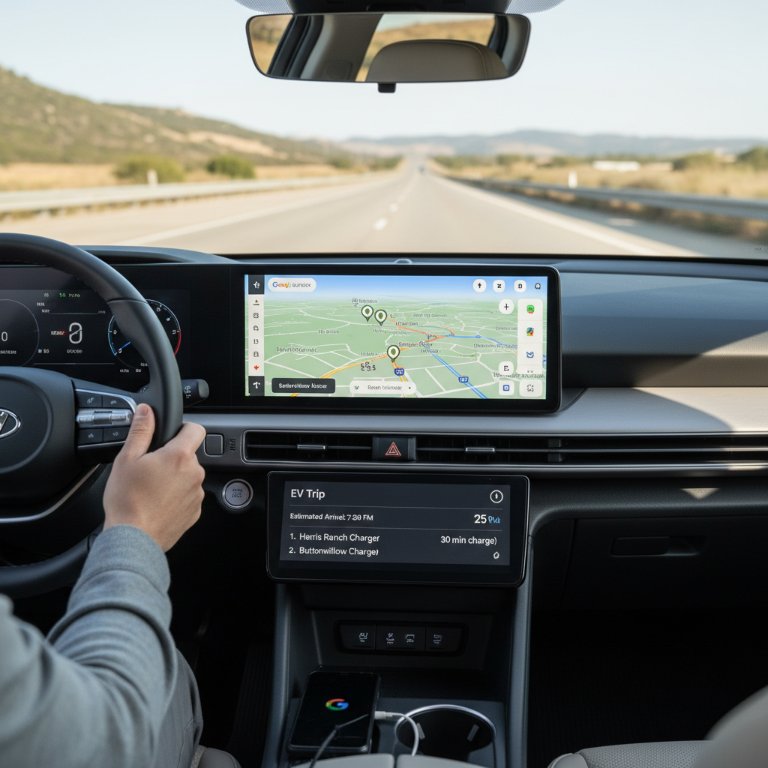
The landscape of electric vehicle ownership just became significantly smoother, thanks to a major expansion of Google Maps’ EV trip planning capabilities. In a move that directly addresses persistent concerns about range anxiety and charging logistics, Google has rolled out advanced battery usage predictions and intelligent charging stop recommendations to over 350 new car models across 16 brands, all seamlessly integrated via Android Auto. This isn't merely an update; it's a profound leap forward in making long-distance EV travel as effortless as internal combustion engine journeys.
For years, EV drivers have grappled with a fragmented ecosystem of in-car navigation systems, often varying wildly in their accuracy and feature sets, alongside a myriad of third-party apps. This latest integration by Google brings a unified, intelligent, and highly accessible solution directly into the dashboards of hundreds of thousands of EV owners, establishing Android Auto as an indispensable companion for the modern electric road warrior. It's a clear signal that the digital experience within an EV is rapidly becoming as critical as its powertrain.
Seamless Integration: Expanding Reach and Intelligence
This expansion means a vast swathe of the EV market can now leverage Google's sophisticated planning tools without ever leaving the Android Auto interface. Drivers simply input their specific EV's details, and the system takes over, providing:
- Precise Arrival Battery Levels: No more guesswork. Drivers receive estimated battery percentages upon arrival at their destination or next charging stop.
- Dynamic ETA Adjustments: Google Maps now intelligently factors in the necessary charging time, providing a realistic and updated Estimated Time of Arrival. This is crucial for planning and managing expectations on longer trips.
- Smart Charging Recommendations: The system suggests optimal charging stops along the route, helping drivers avoid unnecessary detours or the stress of searching for a charger in an unfamiliar area.
The Power Behind the Predictions: Google's AI Advantage
The intelligence underpinning this feature is where Google truly differentiates itself. Unlike basic in-car navigation systems that often rely on static range calculations, Google's solution harnesses the power of its formidable AI and advanced energy models. This sophisticated approach considers a multitude of real-world variables that significantly impact an EV's range and consumption:
- Real-time Traffic Conditions: Adjustments are made for stop-and-go traffic that can affect efficiency.
- Road Elevation Changes: Uphill climbs demand more energy, and Google's models account for this.
- Current Weather Conditions: Temperature, wind, and precipitation can all influence battery performance, and these factors are now incorporated into the predictions.
This dynamic modeling means that Google Maps provides a much more accurate and reliable prediction of battery usage, rivaling the best proprietary systems found in premium EVs like Tesla's integrated navigation, which also leverages extensive real-world data.
Why This Matters:
- For EV Drivers: This is an unmitigated win. The reduction in range anxiety and the simplification of trip planning removes one of the most significant psychological barriers to EV adoption and long-distance travel. It means more confident journeys, better time management, and a generally more enjoyable ownership experience. This feature democratizes sophisticated trip planning, previously the preserve of a few premium brands, making it accessible to a much broader audience.
- For Google and Android Auto: This solidifies Android Auto's position as an indispensable platform in the automotive sector. By solving a critical pain point for EV owners, Google enhances the stickiness of its ecosystem and makes Android Auto an even more compelling offering for both consumers and automakers.
- For Automakers: Brands that have embraced Android Auto, particularly those whose in-house navigation systems might not be as robust or feature-rich, benefit immensely. They can now offer a top-tier EV trip planning experience to their customers without the immense R&D investment required to build such a sophisticated system themselves. This levels the playing field, making their EVs more competitive. Conversely, automakers fiercely guarding their proprietary infotainment systems might find themselves at a disadvantage if they cannot match Google's offering.
- For the EV Market: This signals a maturation of the broader EV ecosystem. As charging infrastructure continues to grow, intelligent software solutions like this are essential to truly unlock the full potential of electric mobility. It fosters greater confidence in the technology and accelerates the transition away from fossil fuels.
The Road Ahead: Seamless and Stress-Free
Google Maps' expanded EV trip planning through Android Auto represents a significant stride towards making electric vehicle ownership truly seamless and stress-free. By leveraging advanced AI and real-world data, Google has delivered a powerful tool that will undoubtedly enhance the daily lives of EV drivers and further accelerate the global shift to electric mobility. We anticipate continued refinement of these models and even deeper integration with charging networks, potentially including real-time charger availability and pricing, further cementing the digital backbone of our electric future.