GM's LMR Battery Gamble Takes Center Stage Amidst Sweeping Climate Deregulation
The electric vehicle landscape is undergoing a profound and complex transformation, with General Motors making a significant technological bet while t...
Editorial Team
World Of EV
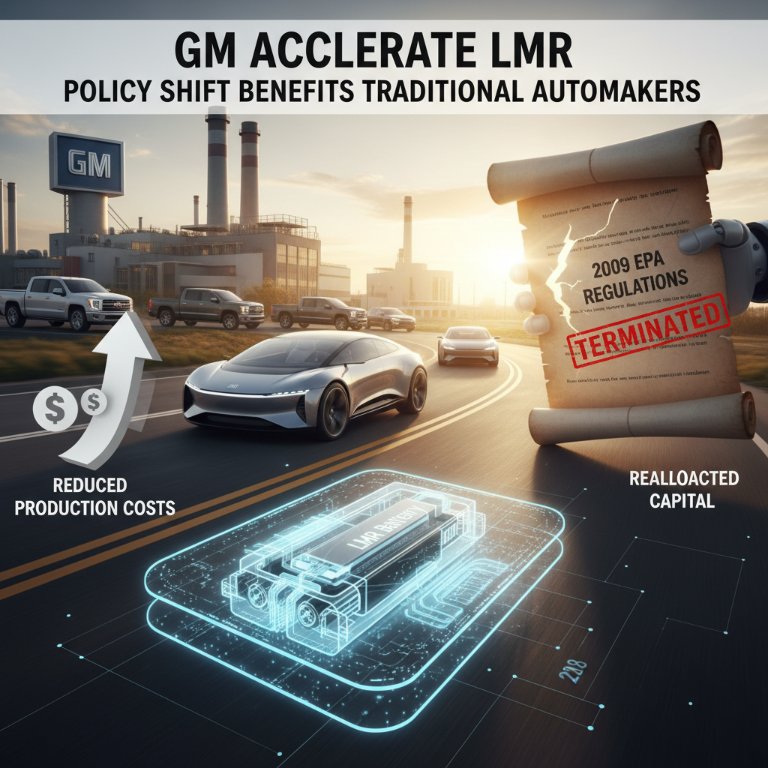
The electric vehicle landscape is undergoing a profound and complex transformation, with General Motors making a significant technological bet while the U.S. regulatory environment performs a dramatic U-turn. As GM accelerates its development of lithium manganese-rich (LMR) batteries with a targeted 2028 deployment, the Trump administration has concurrently terminated the pivotal 2009 'endangerment finding,' dismantling federal climate regulations and greenhouse gas emission standards for cars and trucks. This confluence of internal innovation and external policy reversal creates a highly unpredictable, yet potentially advantageous, path for traditional automakers like GM.
GM's LMR Battery: The Quest for Affordable Range
General Motors is positioning its proprietary LMR battery technology as a cornerstone of its future EV strategy, aiming to introduce its first LMR-powered electric vehicle by 2028. This move is driven by a critical objective: to substantially reduce EV production costs. According to GM, the LMR chemistry will significantly cut cell and pack costs by "several thousand dollars," making electrification more accessible across its lineup.
- Compositional Advantage: LMR batteries dramatically reduce reliance on expensive and geopolitically sensitive materials like nickel and cobalt, instead utilizing abundant and affordable manganese. GM's LMR formulation reportedly consists of approximately 35% nickel, 65% manganese, and virtually no cobalt, a stark contrast to high-nickel chemistries. This shift mitigates supply chain risks and material costs.
- Performance Metrics: While achieving cost points comparable to lithium iron phosphate (LFP) cells, LMR is expected to deliver energy density 33% higher than LFP, allowing for competitive ranges exceeding 400 miles, particularly in larger vehicles like electric trucks and full-size SUVs. Furthermore, GM's LMR technology aims to overcome historical challenges of manganese-rich batteries, such as voltage decay and limited lifespan, by utilizing advanced dopants, coatings, and process optimizations. The technology also promises enhanced low-temperature performance and superior thermal stability compared to some traditional lithium-ion batteries.
- Strategic Diversification: This LMR push is part of GM's broader, diversified battery strategy. The automaker plans to employ high-nickel chemistries for premium, long-range applications, LFP for affordability-focused models, and LMR for the majority of its EVs, balancing range and cost. GM and its partner LG Energy Solution plan to produce these prismatic LMR cells at their Ultium Cells joint venture plants in the U.S., bolstering a localized supply chain.
Regulatory Earthquake: Endangerment Finding Dismantled
In a seismic shift for environmental policy, the Trump administration has officially terminated the 2009 'endangerment finding.' This foundational ruling, established by the EPA in response to a 2007 Supreme Court directive, legally underpinned the federal government's authority to regulate greenhouse gas emissions from sources including cars and trucks under the Clean Air Act. Its termination effectively dismantles a decade and a half of federal climate regulations and emissions standards, marking what President Trump hailed as the "single largest deregulatory action in American history".
The administration claims this policy reversal will inject immediate competitive advantages for traditional automakers like Ford and GM. By removing compliance costs associated with federal climate regulations and greenhouse gas emission standards, manufacturers can reallocate capital away from what the administration termed "high-cost EV mandates". The White House asserted this move would save Americans approximately $2,400 on future vehicle purchases and over $1.3 trillion by eliminating regulatory requirements. Critics, including environmental groups and former President Barack Obama, have widely condemned the action as a dangerous setback for climate efforts and public health, warning of increased pollution and planet-warming emissions.
Why This Matters:
The simultaneous unfolding of GM's ambitious LMR battery program and the dramatic regulatory rollback creates a complex, potentially contradictory, and certainly pivotal moment for the automotive industry, especially for EV adoption in the U.S. This isn't merely news; it's a strategic realignment with far-reaching implications.
- For General Motors: The LMR battery is a crucial, internally driven initiative aimed at achieving EV profitability, a challenge that has plagued legacy automakers. Its success in delivering higher energy density at lower costs is vital for GM to remain competitive, irrespective of external regulations. However, the regulatory easing provides GM (and Ford) considerable breathing room. It effectively loosens the immediate pressure to aggressively push EVs to meet stringent federal emission targets. This could allow GM to pace its EV rollout more strategically, potentially leaning on profitable internal combustion engine (ICE) sales for longer if LMR development faces hurdles or if EV demand softens. It also validates investments in diverse powertrain offerings, including hybrids, to remain competitive for a longer duration.
- For the Broader EV Market: The termination of the 'endangerment finding' signals a clear deceleration of federal regulatory support for electrification. This policy shift directly impacts:
- Winners: In the short term, traditional automakers with robust ICE portfolios gain a competitive advantage by reducing compliance costs. Consumers prioritizing lower initial vehicle costs, or those preferring ICE vehicles, might also benefit from prolonged availability and potentially lower prices of traditional gasoline-powered cars and trucks.
- Losers: Climate goals undoubtedly suffer a significant blow, potentially leading to increased pollution and slowed progress on emission reduction. EV startups, which are singularly focused on electric vehicles and often rely on a clear regulatory push to drive adoption, could face a more challenging market environment without the tailwind of federal mandates. The rapid, widespread EV transition envisioned by many clean energy advocates may also be significantly hampered in the U.S.
- Market Signal: This regulatory pivot sends a strong message: the U.S. market's transition to EVs may become less government-mandated and more market-driven, influenced by consumer demand and technological breakthroughs rather than regulatory stick. It risks fragmenting the global automotive market, with the U.S. potentially slowing its pace compared to regions like Europe and China that maintain aggressive electrification targets.
In essence, while GM is making a necessary, internal strategic move to build cost-effective EVs, the federal government has simultaneously removed a major external impetus for the entire industry to electrify rapidly. This dynamic means the success of GM's LMR bet, and the pace of EV adoption in the U.S., now relies even more heavily on its intrinsic appeal to consumers – offering compelling performance at an undeniable value proposition.
The automotive industry finds itself at a profound crossroads, where the relentless pursuit of technological innovation like GM's LMR battery clashes with a dramatically shifting political and regulatory climate. The path to a fully electrified future just became significantly more complex and less predictable, demanding greater agility and consumer focus from every player.