GM's Five-Minute EV Charge: A Seismic Shift for Electric Mobility
General Motors just fired a major salvo in the electric vehicle revolution, unveiling its groundbreaking XFC (Extreme Fast Charge) cell technology. Th...
Editorial Team
World Of EV
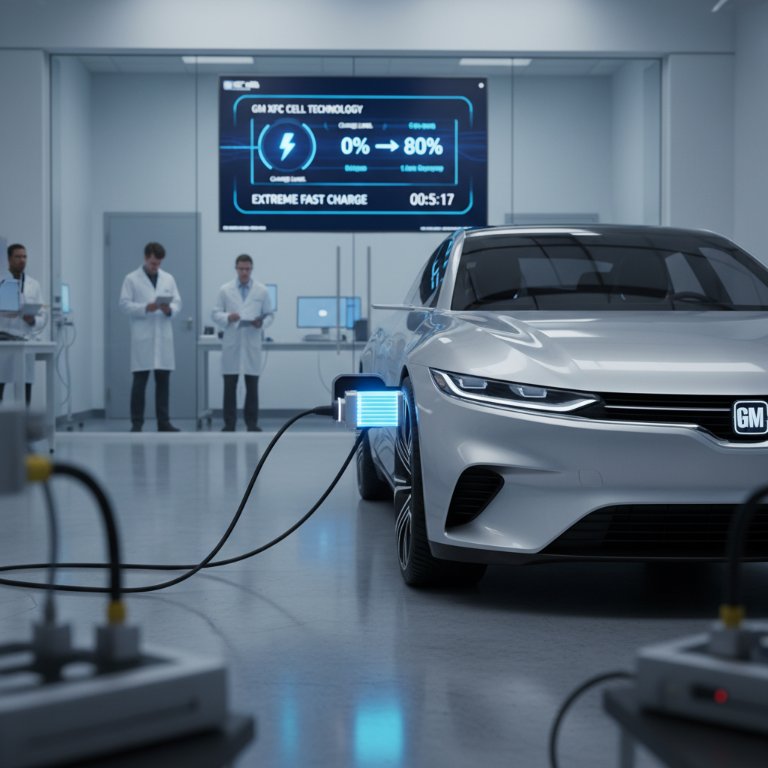
General Motors just fired a major salvo in the electric vehicle revolution, unveiling its groundbreaking XFC (Extreme Fast Charge) cell technology. This innovation promises to recharge an EV battery in just over five minutes, a speed that could fundamentally reshape the automotive landscape and finally put the long-standing 'charging time' critique of EVs to rest.
For years, EV adoption has grappled with the twin anxieties of range and charging duration. While range figures have steadily climbed, the notion of lengthy charging stops has remained a significant psychological and practical hurdle for many prospective buyers. GM's XFC technology directly addresses this, pushing charging speeds into territory previously dominated by gasoline refueling.
The XFC Breakthrough: Speed, Chemistry, and Cost
GM's XFC cell technology boasts an impressive capability: charging from 10% to 70% in approximately 5.6 minutes. This puts it on a clear path towards achieving a full vehicle charge in the coveted three-to-five-minute window. The technical ingenuity behind this advancement lies in its unique battery chemistry and design:
LFP Cathode with Silicon Anode: The XFC cell combines a lithium iron phosphate (LFP) cathode, often lauded for its reliability and cost-effectiveness, with a novel silicon-based anode. This is a crucial distinction, as traditional LFP batteries have historically struggled with rapid charging speeds.
Targeted Surface Treatments: GM engineers have overcome LFP's charging limitations through specialized surface treatments of the electrodes. These treatments enable the battery to handle high currents without compromising mechanical durability or accelerating wear, a common challenge with ultra-fast charging.
Manufacturability and Cost-Effectiveness: Developed significantly by GM's China science lab, the XFC technology was intentionally designed for mass production and aims for reasonable costs. This focus on scalability and affordability is critical for widespread adoption, preventing it from becoming a niche luxury feature.
To put this in perspective, current industry leaders offer impressive, yet still longer, charging times. For instance, high-performance EVs like the Hyundai Ioniq 5 can add 69 miles of range in five minutes, and some 800-volt architectures can charge from 10% to 80% in as little as 18 minutes. Tesla's 4680 batteries in a Model Y, for comparison, have been observed charging from 9% to 50% in 12 minutes and 9% to 80% in 34 minutes at V3 Superchargers. BYD's Blade Battery can charge from 30% to 80% in about 30 minutes using a 110 kW DC charger, although BYD also has a 'flash-charge' Blade battery variant that promises to recharge in six minutes, supported by a 1000V architecture and 1000kW charging.
GM's existing Ultium platform, which underpins many of its upcoming EVs, already offers strong fast-charging capabilities, with some vehicles capable of 350 kW fast-charging, adding up to 100 miles of range in ten minutes. The XFC cell represents a significant leap even beyond these advanced capabilities.
Why This Matters:
Eliminating Range Anxiety's Twin: The primary barrier to EV adoption for many has been charging time, often overshadowing concerns about range itself. A five-minute charge effectively makes refueling an EV as quick and convenient as filling a gasoline tank, largely eliminating this critical drawback. This will make EVs a more viable and attractive option for long-distance travel and spontaneous trips.
A Boost for GM's Market Position: With its Ultium platform already providing a flexible and scalable foundation for its diverse EV lineup, this XFC technology positions GM as a leader in battery innovation. If GM can successfully integrate and scale this technology across its vehicles, it could significantly gain market share and bolster consumer confidence in its EV offerings. This is a crucial moment for GM to prove its commitment to an all-electric future.
Impact on Resale Value and Infrastructure: EVs with ultra-fast charging capabilities will likely command higher resale values, making slower-charging older models less desirable. Furthermore, this technology puts immense pressure on charging infrastructure providers to upgrade their networks to support such rapid power delivery, potentially accelerating the deployment of higher-power charging stations globally.
Intensified Competition: While GM currently holds the spotlight with this announcement, it will undoubtedly spur competitors to accelerate their own fast-charging research and development. This will benefit consumers across the board as the race for quicker, more efficient charging intensifies.
GM's XFC cell technology marks a monumental step towards truly seamless electric mobility. While full vehicle integration will take several years, the promise of a five-minute charge changes the conversation around EVs entirely. The challenge now lies in scaling this laboratory breakthrough to mass production and ensuring the necessary charging infrastructure can keep pace. The future of electric driving just got a whole lot faster, and the implications for consumers and the industry are profound.