GM's EVs Power Up: Beyond the Road, A New Era of Energy Independence Dawns
Electric vehicles are rapidly redefining their role, moving far beyond mere transportation to become indispensable energy hubs. General Motors is at t...
Editorial Team
World Of EV
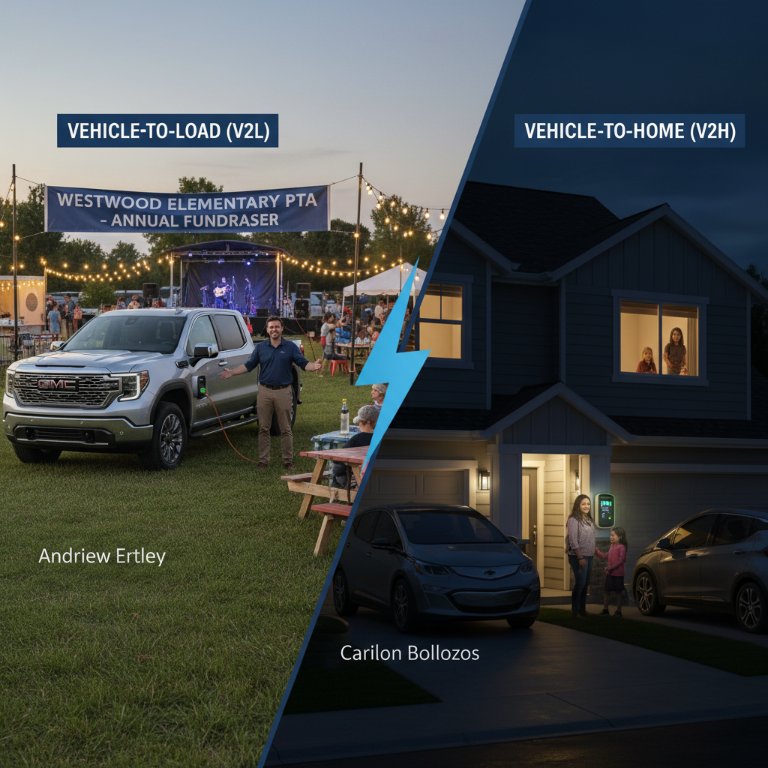
Electric vehicles are rapidly redefining their role, moving far beyond mere transportation to become indispensable energy hubs. General Motors is at the forefront of this transformation, as its EV owners are now routinely leveraging their vehicles' sophisticated capabilities to power everything from community events to entire homes during outages, effectively demonstrating the robust potential of Vehicle-to-Load (V2L) and Vehicle-to-Home (V2H) technologies. This strategic pivot signals a monumental shift in how we perceive and utilize personal mobility, cementing the EV's place as a critical component of a resilient energy future.
Powering Up: V2L and V2H in Action
The practical applications of this burgeoning technology are already making a tangible difference. Andrew Ertley, lead counsel for GM Defense, exemplifies the versatility of V2L. He tapped into his GMC Sierra Denali EV’s integrated GMC Power Station Pro to supply reliable power for lighting at a local PTA fundraiser. This isn't just about convenience; it underscores the ability of modern EVs to act as substantial mobile power sources, eliminating the need for bulky, noisy, and emission-heavy gasoline generators for off-grid power needs.
Even more critical is the burgeoning use of Vehicle-to-Home (V2H) systems. Carolyn Bollozos, Finance Manager for GM Energy, highlighted the profound impact of her investment in a GM Energy Home System. During unforeseen power outages, her system flawlessly transitioned her home's energy supply to her EV's battery, providing essential power and, crucially, ensuring the safety and comfort of her children amidst extreme temperatures. This showcases the fundamental shift in homeowner resilience, moving from passive dependence on an often-unreliable grid to active energy independence facilitated by their EV. While other manufacturers like Ford with its F-150 Lightning and Hyundai/Kia with their V2L offerings have paved some ground, GM’s expanding ecosystem, particularly with the GM Energy Home System, positions it strongly in this emerging market segment.
Beyond the Battery: GM's Broader Energy Vision
These real-world applications are not isolated incidents but rather a deliberate manifestation of GM's broader vision, spearheaded by GM Energy. The company is actively integrating its Ultium platform-based EVs into a comprehensive energy ecosystem designed to offer seamless power solutions. This strategy transcends the traditional automotive business model, positioning GM not just as a car manufacturer, but as a key player in distributed energy solutions. The emphasis is on transforming a high-capacity EV battery from a singular-purpose power source (for propulsion) into a multi-functional energy asset capable of supporting homes, communities, and eventually, the broader electrical grid. This move is critical as the industry increasingly recognizes that the true value of an EV lies not just in its ability to drive, but in its ability to store and deploy energy.
The Road Ahead: The Promise of V2G
Looking forward, the evolution from V2L and V2H to full Vehicle-to-Grid (V2G) capability represents the ultimate frontier. V2G technology promises to allow EVs to not only draw power from the grid but also to feed surplus energy back into it during peak demand or emergencies. This bidirectional flow of energy holds immense potential for enhancing grid resilience, stabilizing power supplies, and even generating potential revenue for EV owners through smart energy management programs. GM's foundational work with V2L and V2H is laying the groundwork for this sophisticated future, where millions of EV batteries could collectively act as a massive, distributed energy storage system, revolutionizing energy infrastructure as we know it.
Why This Matters:
This evolving narrative around GM's electric vehicles signals a profound paradigm shift that will reshape the automotive and energy landscapes. It’s no longer simply about buying an EV for its environmental benefits or performance; it’s about investing in a mobile energy asset that provides unprecedented utility and peace of mind.
-
Who Wins? EV owners are the clear victors, gaining remarkable versatility and resilience. The ability to power a home during an outage, run tools remotely, or even support community events adds significant tangible value to their vehicle investment. GM also wins by differentiating its EV offerings and cementing its position as an innovator in the burgeoning energy services market. Utilities stand to gain immensely from future V2G integration, which offers a powerful tool for grid stabilization and demand-side management.
-
Who Loses? Traditional internal combustion engine vehicles, already facing obsolescence due to emissions and efficiency, lose further ground as their singular utility (transportation) is starkly contrasted against the multi-faceted energy capabilities of modern EVs. Manufacturers who fail to integrate robust V2L/V2H/V2G solutions into their EV platforms risk being left behind in a rapidly evolving market.
-
What Does This Signal to the Market? The market is receiving a clear message: the future of personal transportation is intrinsically linked to energy management. Automakers are rapidly transforming into energy solution providers. Competition will intensify not just on range and charging speed, but on the sophistication and integration of vehicle-to-everything (V2X) capabilities.
-
Is This a "Do-or-Die" Moment? While perhaps not an immediate "do-or-die" for GM, the strategic emphasis on these energy capabilities is absolutely critical for long-term leadership. In an increasingly competitive EV landscape, companies that offer a comprehensive energy ecosystem alongside their vehicles will capture market share and customer loyalty. Neglecting this crucial aspect would be a strategic misstep, risking irrelevance as consumer expectations for EV utility expand dramatically.
The Road Ahead: A Connected Energy Future
GM's proactive strides in V2L and V2H are ushering in an era where EVs are no longer merely transportation devices but central figures in our energy infrastructure. As the industry progresses toward ubiquitous V2G capabilities, the lines between personal mobility and energy management will continue to blur, offering a future of unprecedented convenience, resilience, and sustainability. For savvy EV enthusiasts and prospective buyers, this means investing in more than just a car; it's an investment in a dynamic, adaptable, and powerful piece of tomorrow's energy grid.