GM's $7.6 Billion EV Reckoning: A Wake-Up Call for the Entire Industry
General Motors, once a beacon of aggressive electrification with ambitious targets, is now navigating a tumultuous financial landscape, having incurre...
Editorial Team
World Of EV
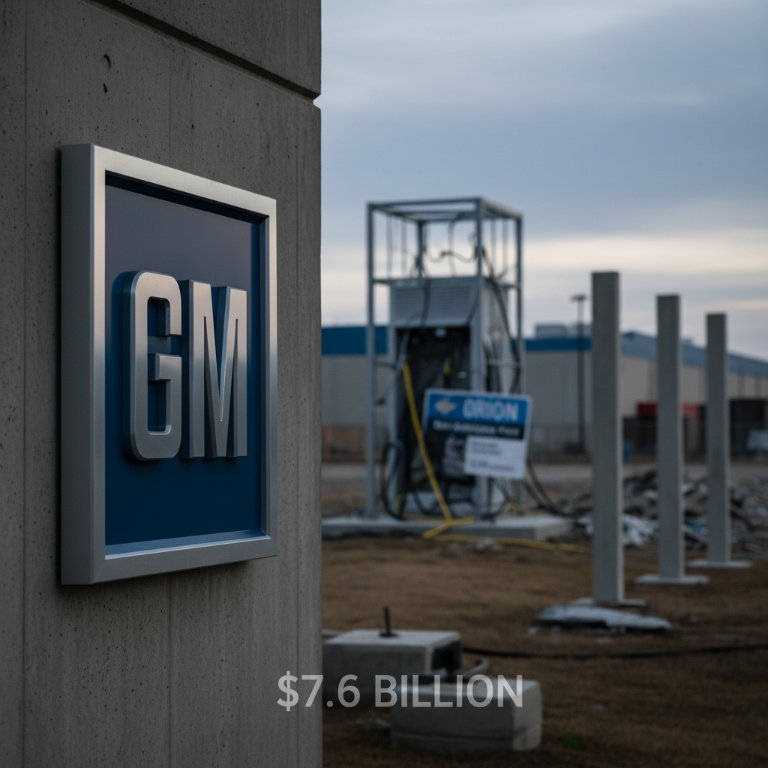
General Motors, once a beacon of aggressive electrification with ambitious targets, is now navigating a tumultuous financial landscape, having incurred a staggering $7.6 billion in EV-related charges in 2025. This colossal figure highlights the significant headwinds facing the legacy automaker's electric vehicle strategy, with expectations for these costs to persist deep into 2026.
After years of projecting a swift and seamless transition to an all-electric future, GM's current reality reflects a tougher market. The company is actively adjusting its EV production plans and investments, a direct response to weaker-than-expected consumer demand and shifts in regulatory policies that are reshaping the industry's trajectory. This marks a profound pivot from the earlier 'go-go' years of EV enthusiasm, forcing a re-evaluation of both pace and investment strategy.
A Costly Correction and Industry-Wide Retraction
The $7.6 billion in charges represents not just operational losses but a broad recalibration of GM's EV ambitions. These costs are a direct consequence of a demand curve that has not bent as steeply upward as anticipated, coupled with a regulatory environment that, while still pushing for electrification, is showing signs of flexibility in the face of market realities. GM's predicament is not an isolated incident; the broader industry witnessed cancellations of $22 billion in announced EV and battery manufacturing projects across the US in 2025.
- Total industry cancellations: $22 billion in announced US EV and battery projects in 2025.
- GM's largest single cancellation: A $4.3 billion project at its Orion, Michigan, plant, initially slated for significant EV battery and vehicle production.
This trend underscores a significant cooling of investment appetite, as manufacturers grapple with the immense capital requirements and uncertain returns of a rapidly evolving market. The Orion cancellation, in particular, signals a strategic retreat from previously committed expansion, impacting future production capacity and regional economic development.
The Software Silver Lining?
Amidst the financial setbacks on the hardware front, GM is attempting to find a silver lining by focusing on building recurring revenue streams through software services. Platforms like OnStar represent a critical strategic avenue for the company to generate income independent of vehicle sales. This diversification acknowledges that the future of automotive profitability may lie not just in manufacturing vehicles, but in the digital services and subscriptions they enable. It’s a classic tech-industry playbook being applied to a traditional automaker, a necessary evolution if GM is to stabilize its financial performance in the long term.
Why This Matters:
GM's $7.6 billion in EV-related charges is more than just a balance sheet entry; it's a stark signal for the entire automotive and investment landscape. This isn't a minor bump in the road; it's a significant financial reckoning that demands a re-evaluation of how rapidly and extensively the industry can transition to electric vehicles. For GM, this is a critical juncture – a moment that will define its strategic agility and long-term viability in the electric era.
Who Wins? Who Loses? Companies with more flexible production lines, a diversified powertrain strategy (including strong hybrids), and a sharper focus on cost control are likely to emerge stronger. Startups with lean operations and targeted market approaches might also find new opportunities amidst the recalibration. Conversely, automakers that over-committed to an aggressive all-EV timeline without sufficient market validation, as GM arguably did, face substantial financial penalties and potential competitive disadvantages. Shareholders, in the short to medium term, will bear the brunt of these multi-billion-dollar write-downs, while workers in affected manufacturing projects face uncertainty.
The Signal to the Market: This situation provides a crucial reality check for the broader EV market. The initial surge of optimism and investment, often fueled by regulatory mandates and environmental aspirations, is now confronting the economic realities of consumer choice, infrastructure challenges, and the sheer cost of retooling an entire industry. It suggests that while the EV transition is inevitable, its pace will be more measured and its path less linear than previously assumed. It also validates arguments for a multi-energy future, where internal combustion engines and hybrids will continue to play a vital role for longer than many initially predicted.
GM's costly encounter with the realities of EV adoption serves as a powerful lesson: ambition must be tempered by market dynamics and a robust understanding of consumer willingness to pay. The road to an all-electric future remains paved with good intentions, but increasingly, also with significant financial hurdles. How GM adapts its strategy now will dictate its standing in the transformed automotive landscape.