GM's $6 Billion EV Reckoning: Tax Credit Cliff and Policy Shifts Force Major Reset
General Motors, a titan of American automotive manufacturing that has staked its future firmly on an all-electric transformation, has reported a stagg...
Editorial Team
World Of EV
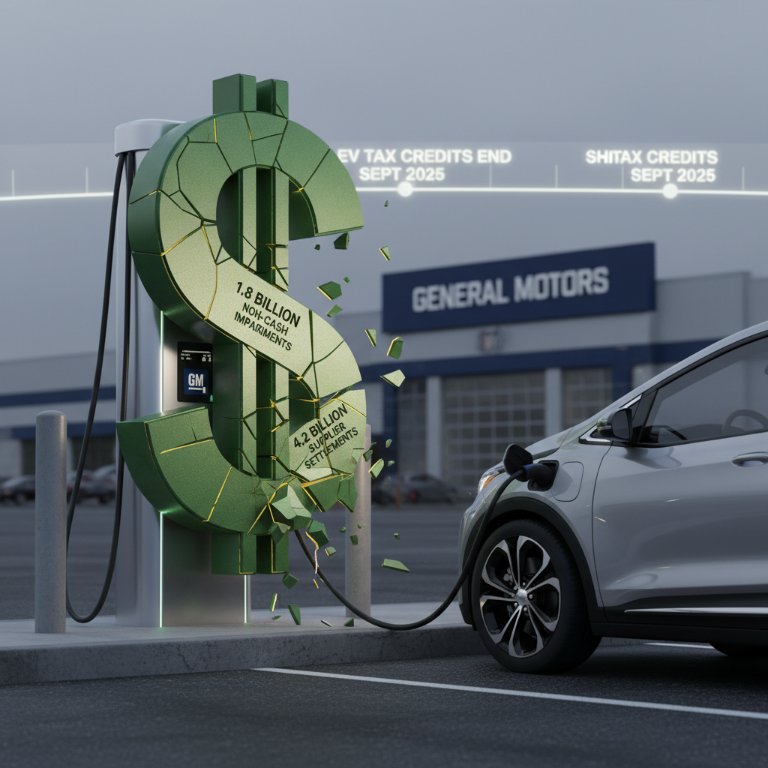
General Motors, a titan of American automotive manufacturing that has staked its future firmly on an all-electric transformation, has reported a staggering $6 billion in charges. This substantial financial hit, attributed directly to the impending conclusion of federal EV tax credits in September 2025 and the broader impact of shifting economic and environmental policies, signals a crucial inflection point not just for GM, but for the entire EV industry. It’s a stark reminder that the transition to electric vehicles, while inevitable, will be fraught with financial challenges once the foundational support of government incentives begins to erode.
The $6 Billion Breakdown
The reported charges encompass a multifaceted financial strain on the automaker. Approximately $1.8 billion constitutes non-cash impairments and other non-cash charges. More significantly, around $4.2 billion is allocated for supplier commercial settlements, contract cancellation fees, and other related expenses. This breakdown suggests that GM is not only adjusting the valuation of its current EV assets but is also actively restructuring its supply chain and contractual obligations in anticipation of a challenging post-incentive landscape. Such a move indicates a fundamental reassessment of its production plans and market projections.
The End of an Era: The Tax Credit Cliff
The most immediate and impactful driver behind these charges is the scheduled expiration of federal EV tax credits in September 2025. For years, these incentives have been a critical catalyst for EV adoption, effectively subsidizing the purchase price for consumers and significantly bolstering sales volumes for manufacturers. GM, like many legacy automakers, has heavily relied on these credits to make its new, often premium-priced, Ultium-powered EVs more palatable to a wider audience. The impending 'tax credit cliff' forces GM to confront a market where its products must compete on their inherent value, technology, and price point alone, without the artificial boost of government aid. This shift will undoubtedly impact demand, particularly for models occupying higher price segments where the credit offered a substantial reduction in buyer outlay.
Shifting Tides: Economic and Environmental Policy Headwinds
Beyond the tax credits, GM points to a broader landscape of 'shifting economic and environmental policies.' This refers to a complex interplay of factors, including fluctuating fuel prices, rising interest rates impacting consumer financing, and evolving regulatory environments globally. While the long-term commitment to emissions reduction remains, the pace and specifics of policy implementation can introduce significant uncertainty for manufacturers making multi-billion-dollar investments. Furthermore, a potential softening in overall EV demand, or a shift in consumer preference towards more affordable EV options or even hybrids, could exacerbate the challenges for companies like GM that have bet heavily on a rapid, full-scale transition to battery electric vehicles.
Why This Matters:
This $6 billion charge is far more than a blip on GM's balance sheet; it's a profound market signal that will resonate throughout the automotive world. For GM, it underscores the immense financial pressure of scaling EV production while simultaneously navigating a maturing market where subsidies are shrinking. This is a stress test for its ambitious Ultium platform strategy, forcing a rigorous examination of cost structures, production efficiencies, and market viability for its entire EV portfolio.
Who Wins?
- Manufacturers with highly cost-effective EV platforms, strong supply chain resilience, and diversified product offerings (including compelling hybrids) that are less reliant on incentives will likely gain market share.
- Companies that can quickly pivot to offering more affordable, mass-market EVs will also be better positioned.
Who Loses?
- GM's shareholders bear the immediate financial brunt, and consumers who were banking on continued incentives for future EV purchases might face higher out-of-pocket costs.
- Suppliers caught in contract cancellations also face significant disruption.
- More broadly, the industry could see a temporary slowdown in EV adoption if the pricing sweet spot isn't quickly reached without government intervention.
This moment signals a crucial shift from an incentivized growth phase to a more competitive, market-driven era for EVs. It’s a wake-up call for every automaker: the era of government-backed tailwinds is receding, and true innovation, cost discipline, and compelling value propositions are now paramount. For GM, this isn't a 'do-or-die' moment in the existential sense, but it is certainly a 'do-or-adapt-quickly' challenge that will define its success in the coming years. The future of its EV leadership hinges on how effectively it can absorb these charges and recalibrate its strategy for a post-subsidy world.
The Road Ahead
GM's significant charges are a stark indicator that the path to an all-electric future is not a smooth, uninterrupted highway, but rather a terrain with unexpected financial potholes. As the industry moves past the initial wave of government support, automakers must demonstrate not just technological prowess, but also robust financial discipline and the ability to adapt to a rapidly evolving market. How GM recalibrates its EV strategy and cost structure in the wake of this $6 billion hit will be a critical storyline to follow, offering valuable insights into the broader challenges and opportunities awaiting the entire electric vehicle ecosystem.