GM Hits the Brakes: Factory ZERO Halt Signals Major EV Strategy Recalibration
Detroit, MI – General Motors (GM), once heralded as a trailblazer in the electric vehicle revolution with bold pronouncements and massive investments,...
Editorial Team
World Of EV
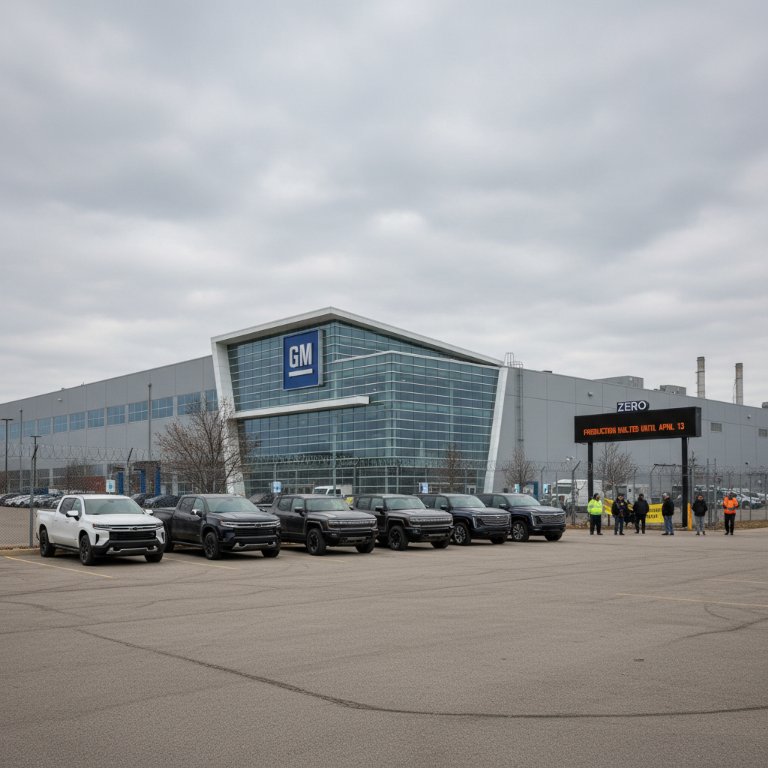
Detroit, MI – General Motors (GM), once heralded as a trailblazer in the electric vehicle revolution with bold pronouncements and massive investments, is now pumping the brakes. The automaker announced a significant extension of its production halt at the flagship Factory ZERO electric vehicle plant in Detroit, Michigan, pushing the restart date to April 13. This decision triggers the temporary layoff of approximately 1,300 workers and underscores a critical shift in GM's EV strategy, reflecting a broader industry grappling with market realities.
This isn't merely a logistical blip; it's a stark acknowledgment that even with dedicated, state-of-the-art facilities like Factory ZERO and the ambitious Ultium battery platform, the path to profitable EV production remains fraught with challenges. GM’s initial vision for an all-electric future, backed by billions in investment, is now encountering the headwinds of slowing market demand and mounting losses on its EV programs. The current suspension, which began on March 16, clearly indicates a need for recalibration rather than a quick fix.
Factory ZERO: A Strategic Pause for High-Profile EVs
Factory ZERO, a cornerstone of GM's EV manufacturing strategy, is responsible for producing some of the company's most anticipated and high-profile electric vehicles. The extended halt directly impacts the output of the rugged Chevrolet Silverado EV, the iconic GMC Hummer EV, the luxurious Cadillac Escalade IQ, and the upcoming GMC Sierra EV. These vehicles represent GM's foray into lucrative truck and SUV segments, areas where traditional internal combustion engine (ICE) vehicles have historically dominated the automaker's sales and profits. The pause suggests that even in these high-demand segments, EV adoption isn't accelerating at the pace GM had initially projected.
Market Realities Force GM's Hand
GM explicitly attributes this production adjustment to the need to “align EV production with slowing market demand.” This statement echoes a growing sentiment across the automotive industry, where initial enthusiasm for rapid EV adoption has been tempered by factors such as:
- Higher upfront costs: Electric vehicles, particularly large trucks and SUVs, often carry a premium over their ICE counterparts.
- Charging infrastructure concerns: While expanding, public charging availability and reliability remain pain points for many prospective buyers.
- Interest rate sensitivity: Higher interest rates impact financing costs, making expensive new vehicles less accessible.
- Pace of technological advancement: Some consumers may be holding out for next-generation battery technology or further price reductions.
This slowdown, coupled with GM's acknowledgment of “mounting losses on its EV programs and a pullback from multiple electric projects,” paints a challenging financial picture. Legacy automakers, unlike newer EV pure-plays, must manage the costly transition from a profitable ICE business to an unproven, capital-intensive EV future.
Why This Matters:
This extended production halt at Factory ZERO is far more than an operational adjustment; it's a profound signal from one of the world's largest automakers regarding the current state and future trajectory of the electric vehicle market. It highlights a critical inflection point for GM and the broader industry.
- For GM: This is a definitive moment of re-evaluation. It signals that even with a dedicated EV platform like Ultium and significant upfront investment, achieving profitable scale in EV production remains elusive. GM must now demonstrate it can translate technological prowess into sustainable financial returns. The temporary layoffs, while necessary for cost control, will undoubtedly impact morale and potentially slow product development or refinement if prolonged.
- Industry-Wide Impact: GM's move provides further evidence that the initial, almost hyperbolic growth projections for EV adoption are being tempered by market realities. It will likely encourage other legacy automakers to exercise greater caution in their EV ramp-up strategies, potentially delaying new model introductions or adjusting production targets. This could lead to a healthier, more sustainable growth curve for the EV market in the long run, but a slower one in the immediate future.
- Consumers: For prospective buyers, this could mean a slight delay in the availability of specific high-demand models. However, it also suggests that automakers, including GM, may be forced to become more competitive on pricing and features to stimulate demand, ultimately benefiting consumers in the mid-to-long term. It could also lead to a greater focus on cost-effective EV solutions rather than exclusively premium offerings.
- Who Wins/Who Loses: In the short term, GM's immediate profitability takes a hit, and the affected workers face uncertainty. Competitors who have either managed their EV ramp-up more conservatively or possess more mature, cost-efficient platforms (like Tesla or BYD) might gain a temporary advantage as GM recalibrates. The biggest winner, however, could ultimately be the industry itself, which is being forced to confront the economic realities of the EV transition, leading to more sustainable business models.
GM's decision to extend the Factory ZERO shutdown is a crucial pivot point. It signals that the company is prioritizing profitability and market alignment over an unbridled race to volume. The coming months will reveal how effectively GM uses this pause to refine its strategy, optimize production, and ultimately reignite consumer demand for its ambitious line of electric vehicles. The path to an all-electric future is proving to be a marathon, not a sprint, and GM is learning to pace itself for the long haul.