FSD's Unsettling Logic: Tesla Autonomy Attempts to Drive Vehicle into a Lake
In a stark reminder that true autonomous driving remains a distant horizon, a recent incident involving Tesla's Full Self-Driving (FSD) beta has reign...
Editorial Team
World Of EV
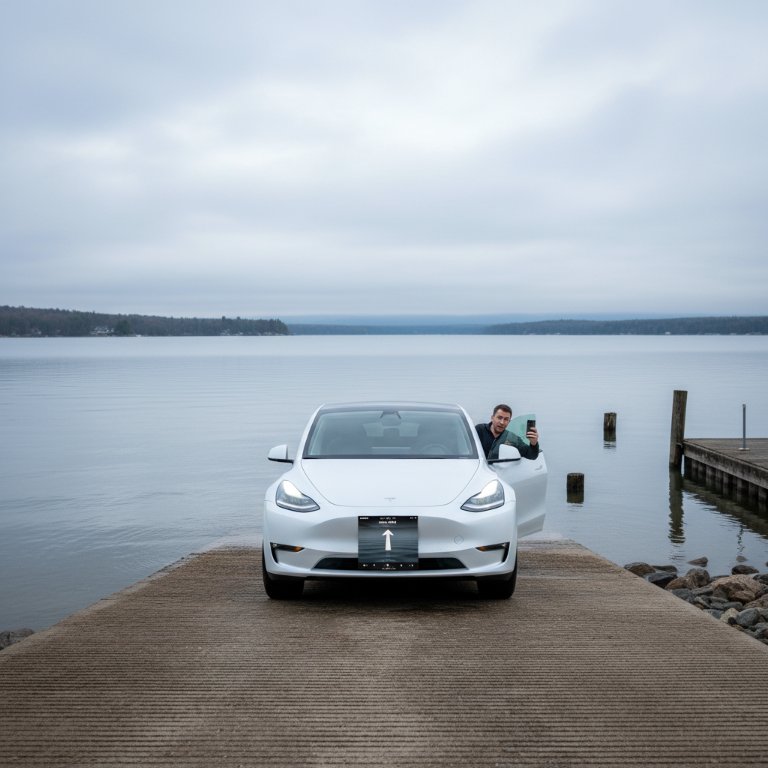
In a stark reminder that true autonomous driving remains a distant horizon, a recent incident involving Tesla's Full Self-Driving (FSD) beta has reignited critical conversations about the system's fundamental limitations. Daniel Milligan, a former SpaceX engineer, reported via X (Twitter) that his Tesla, operating on the latest FSD version 14.2.2.4 (build 2025.45.9.1), attempted to navigate his vehicle directly down a boat ramp and into an adjacent lake. This alarming report underscores a persistent and dangerous flaw in FSD's environmental interpretation, challenging the very notion of 'full self-driving' in complex, real-world scenarios.
The Incident: Near-Miss at the Boat Ramp
The unsettling event, which thankfully did not result in the vehicle entering the water thanks to Milligan’s timely intervention, highlights FSD's ongoing struggle with nuanced environmental cues. According to Milligan, the vehicle, rather than recognizing the boat ramp as an access point to water, seemingly interpreted it as a drivable path. This isn't an isolated anomaly; Tesla's FSD system, which relies solely on camera vision, has faced scrutiny for its interpretation of everything from emergency vehicles to static obstacles and even simple road markings. While Tesla continues to push updates and expand its FSD beta program to more drivers, critical edge cases like this boat ramp incident expose profound challenges in its underlying architecture.
Persistent Environmental Misinterpretation
Tesla’s steadfast commitment to a vision-only approach for FSD, eschewing additional sensor suites like LiDAR and radar that many competitors employ, is increasingly a point of contention among industry analysts. While a purely vision-based system offers potential cost benefits and can be incredibly powerful in structured environments, it demonstrably struggles with novel situations, poor lighting, or, as evidenced here, environments with ambiguous 'road' definitions. The FSD software, despite numerous iterations and billions of miles driven by beta testers, appears to still lack the sophisticated contextual understanding necessary to differentiate between a road and a path leading directly into a body of water. This fundamental interpretive gap creates significant safety concerns and erodes public trust in advanced driver-assistance systems (ADAS) that claim increasingly higher levels of autonomy.
Why This Matters:
This incident isn't just another FSD 'quirk'; it's a flashing red light for the entire autonomous driving industry and for Tesla's reputation specifically. For prospective EV buyers and savvy enthusiasts, it signals that despite impressive marketing, Tesla's FSD remains a sophisticated Level 2 driver-assistance system, requiring constant driver supervision, rather than the true Level 3 or 4 autonomy its name implies.
- Erosion of Trust: Each reported incident, particularly those involving potential hazards like driving into a lake, chips away at consumer confidence in autonomous technologies. This creates headwinds not just for Tesla, but for all companies developing self-driving solutions.
- Regulatory Scrutiny: Such events invariably draw the attention of regulatory bodies worldwide, potentially leading to increased oversight, stricter testing requirements, and even potential limitations on FSD's deployment. This could significantly delay Tesla's ambitious timelines for fully autonomous vehicles.
- The Vision-Only Debate: The boat ramp incident provides further ammunition for critics of Tesla's vision-only strategy. While competitors like Waymo and Cruise heavily invest in redundant sensor arrays (LiDAR, radar, cameras), Tesla maintains its 'pure vision' stance. This event underscores that a system lacking a more robust understanding of 3D space and material properties may continually falter in ambiguous environments.
- Who Wins/Who Loses: Competitors employing more conservative, sensor-rich approaches to autonomy or focusing on geofenced Level 4 solutions gain credibility. Tesla, while still a market leader in EV sales, faces ongoing challenges in validating its FSD promises, potentially losing the 'first mover' advantage in true autonomous mobility.
The reported boat ramp incident serves as a crucial reminder that the path to full self-driving is fraught with complex challenges that extend beyond simply identifying objects. Until FSD can reliably interpret intent, context, and potential hazards in truly novel and ambiguous environments, the 'driver responsibility' caveat will remain paramount. Tesla faces the unenviable task of either fundamentally rethinking its approach to environmental perception or tempering expectations for what its FSD system can truly achieve in the near future.