Ford's Billion-Dollar Pivot: Shifting from Underutilized EV Capacity to Powering the Grid and AI
Ford Motor Company, a titan grappling with the intricate dance of the automotive transition, has just announced a monumental strategic shift, committi...
Editorial Team
World Of EV
Ford Motor Company, a titan grappling with the intricate dance of the automotive transition, has just announced a monumental strategic shift, committing a staggering $2 billion to retool its manufacturing facilities in Kentucky and Michigan. This isn't just a reallocation; it's a dramatic pivot away from underutilized battery-electric vehicle (BEV) capacity and squarely into the booming market for utility-scale energy storage. This move signals a profound recalibration of Ford’s electrification strategy, acknowledging both the realities of current EV demand and the explosive growth in grid infrastructure and artificial intelligence data center requirements.
For years, Ford, like many legacy automakers, has invested heavily in building out its internal battery production capabilities, aiming for vertical integration in the burgeoning EV market. While Ford's commitment to electric vehicles like the F-150 Lightning and Mustang Mach-E remains firm, this $2 billion redeployment is a clear admission that the initial projections for in-house battery cell production capacity for vehicles may have outpaced immediate demand. Instead of allowing valuable manufacturing assets to sit idle, Ford is demonstrating impressive agility, redirecting its considerable resources to an area of urgent and escalating need: energy storage solutions that will underpin our future electrified economy.
The Big Pivot: From EV Batteries to Grid Storage
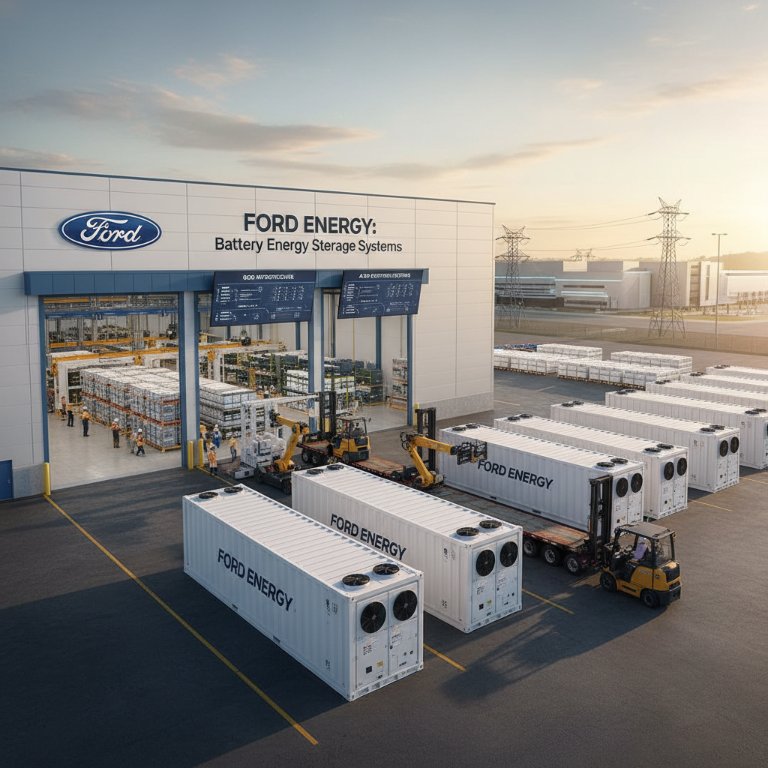
Ford's decision to retool its Glendale, Kentucky facility is the most striking example of this strategic redirection. Originally earmarked for specific BEV battery production, the plant will now focus on producing lithium iron phosphate (LFP) cells. This isn't just about cell chemistry; it's about the entire ecosystem. Crucially, Glendale will also become a hub for manufacturing large DC containerized systems, designed to serve the voracious appetites of grid infrastructure and the burgeoning demand from AI data centers. This move is not merely a tactical adjustment but a fundamental reorientation towards a broader energy play, recognizing the synergistic relationship between vehicle electrification and grid stability.
Glendale's New Purpose: LFP Cells and Containerized Systems
- Lithium Iron Phosphate (LFP) Cell Production: The shift to LFP chemistry is significant. LFP batteries are known for their enhanced safety, longer cycle life, and lower cost compared to nickel-manganese-cobalt (NMC) chemistries, making them ideal for stationary energy storage applications where volumetric energy density is less critical than durability and economics.
- Large DC Containerized Systems: These integrated energy storage units are critical for grid modernization, renewable energy integration, and providing reliable backup power. Their application extends directly to supporting the immense power demands of new AI data centers, which are proliferating globally and require robust, scalable energy solutions.
Why This Matters:
This strategic pivot by Ford is far more than an internal accounting adjustment; it sends potent signals across multiple industries. Firstly, for Ford, it's a shrewd move that demonstrates adaptability and financial prudence. Instead of being tethered to potentially overbuilt EV battery lines, Ford is diversifying its energy portfolio, tapping into a market where demand is currently skyrocketing and margins could be more stable. This isn't a retreat from EVs, but a sophisticated expansion into the broader energy transition, leveraging manufacturing expertise in a new, high-growth sector. Ford wins by maximizing asset utilization and tapping into new revenue streams from critical infrastructure.
Secondly, this move underscores the immense pressure on global energy grids and the unprecedented demands of the AI revolution. The need for robust, reliable, and scalable energy storage solutions is no longer a niche market; it's a foundational requirement for economic growth and technological advancement. Companies building and operating massive AI data centers are desperately seeking stable power, and Ford is positioning itself as a key supplier in this critical supply chain.
Finally, for the wider EV battery industry, Ford's pivot could be seen as a bellwether. While EV sales continue to grow, the pace of growth in some segments has moderated, leading to a re-evaluation of capacity planning. This decision may prompt other automakers or battery manufacturers to consider similar diversifications, exploring adjacent markets where their core competencies in battery technology and manufacturing can be strategically redeployed. It highlights that the energy transition is multifaceted, extending well beyond just powering vehicles.
Ford's redeployment of $2 billion into utility-scale energy storage marks a significant turning point, underscoring the company's commitment to a more diversified and resilient energy strategy. By focusing on LFP cells and large DC containerized systems for grid infrastructure and AI data centers, Ford is not only optimizing its manufacturing assets but also positioning itself at the forefront of critical technologies essential for the future of energy. This isn't just about cars anymore; it's about powering the future, intelligently and efficiently.