Ford's $6 Billion Battery Retreat: A Radical Pivot Towards ESS and Chinese Alliances
Ford Motor Company, in a dramatic and costly strategic re-evaluation, has officially dissolved its ambitious BlueOval SK joint venture with Korean bat...
Editorial Team
World Of EV
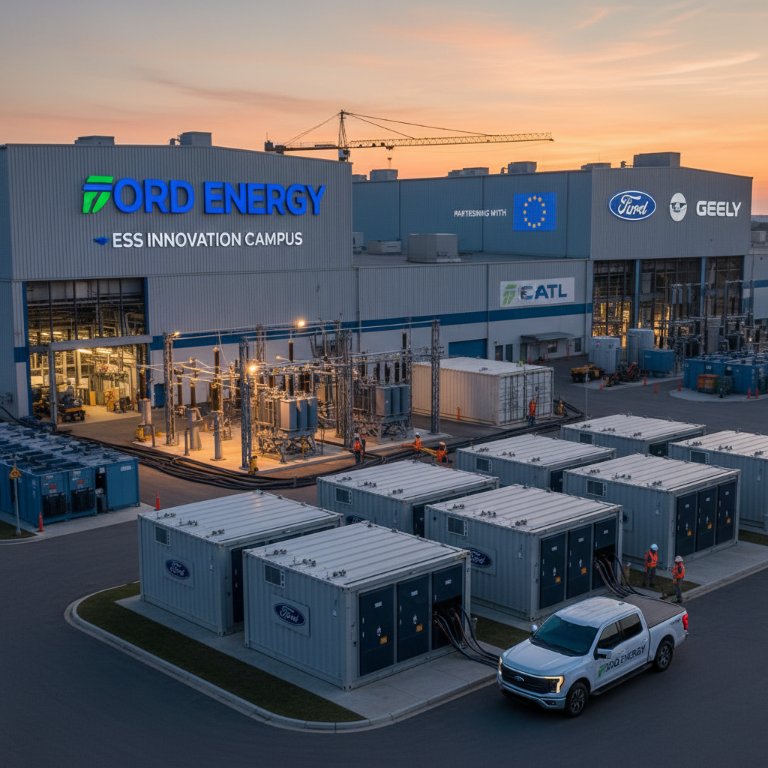
Ford Motor Company, in a dramatic and costly strategic re-evaluation, has officially dissolved its ambitious BlueOval SK joint venture with Korean battery giant SK On. The move, which sees Ford absorb all assets and liabilities, comes with a staggering price tag: a $6 billion loss. This significant financial hit marks a profound course correction in Ford's electrification strategy, signaling a shift away from direct, large-scale EV battery cell manufacturing in Kentucky and towards a diversified future anchored by energy storage systems and deepened partnerships with Chinese industry.
Immediately following the dissolution, Ford announced its intent to invest an additional $2 billion to repurpose these now wholly-owned Kentucky facilities. The new mission? To develop and manufacture battery-based Energy Storage System (ESS) operations under its newly formed subsidiary, Ford Energy. This pivot is not merely a defensive maneuver but a calculated gamble, positioning Ford to capitalize on the burgeoning grid and renewable energy storage market, a sector with immense growth potential beyond just electric vehicles.
The BlueOval SK Fallout: A Costly Course Correction
For years, Ford championed vertical integration as a cornerstone of its EV ambitions, with the BlueOval SK joint venture representing a critical plank in its strategy to secure domestic battery supply. The vision for massive battery plants in Kentucky and Tennessee was clear: control the supply chain, reduce costs, and accelerate EV production. However, the unexpected dissolution and the accompanying $6 billion loss indicate formidable challenges, likely encompassing escalating costs, technological hurdles, or perhaps a reassessment of the competitive landscape for battery cell manufacturing in North America. This stark financial reality forces Ford to reassess its path forward, demonstrating the immense capital and technological prowess required to compete at the highest levels of battery production.
Ford Energy Rises: A Bet on Stationary Storage
The creation of Ford Energy and the repurposing of the Kentucky plants for ESS operations signal a strategic expansion beyond the automotive sector. While still battery-centric, ESS targets grid-scale energy storage, residential power solutions, and commercial applications, leveraging similar battery chemistry and manufacturing expertise. This move offers several potential advantages:
- Diversified Revenue Streams: Taps into the rapidly growing market for renewable energy integration and grid stability solutions.
- Leveraging Existing Assets: Makes use of significant infrastructure investments already made in the Kentucky sites.
- Mitigating EV Market Volatility: Provides a hedge against the unpredictable nature of EV sales cycles and intense automotive competition.
This move acknowledges the broader energy transition and positions Ford not just as an automaker, but as a player in the wider energy ecosystem, potentially emulating companies like Tesla, which has successfully diversified into energy products.
Deepening Ties with China: LFP Batteries and Geely Alliance
Simultaneously, Ford is significantly deepening its cooperation with Chinese battery manufacturers, prominently featuring CATL for lithium iron phosphate (LFP) batteries. This strategic embrace of LFP technology, known for its cost-effectiveness, longer lifespan, and improved safety compared to nickel-cobalt-manganese (NCM) alternatives, is critical for mass-market EVs and aligns with global trends driven by Chinese innovation. Ford's previous struggles to bring competitive, affordable EVs to market have been well-documented, making this LFP pivot essential for cost parity and broader consumer appeal.
Even more remarkably, Ford is in advanced discussions with China's Geely Automobile Holdings for a strategic manufacturing and technology partnership. This potential alliance explores the use of Ford's under-utilized European manufacturing capacity for Geely vehicles, a bold move designed to potentially circumvent stringent EU tariffs on Chinese-made electric vehicles. For Ford, struggling with profitability and overcapacity in its European operations, this partnership could provide a lifeline, bringing much-needed revenue and utilization to its plants while potentially gaining insights into Geely's formidable EV development and manufacturing prowess.
Why This Matters:
This series of announcements represents a seismic shift for Ford, signaling a pragmatic, albeit painful, acknowledgment of the realities of the global EV and energy markets. Who wins? Arguably, Ford's shareholders might eventually win if the ESS pivot proves successful and the Chinese partnerships unlock cost efficiencies and new revenue streams. Consumers could win from more affordable LFP-powered Ford EVs. Geely wins significant access to European manufacturing and market reach. Who loses? SK On, now without a major U.S. partner in these specific Kentucky ventures. Perhaps American jobs tied directly to *Ford's* direct cell manufacturing ambitions in Kentucky. This move also signals a potential loss of 'American-made' pride in the core EV battery component. What does this signal to the market? It loudly proclaims that vertical integration in battery manufacturing is incredibly difficult and expensive, potentially too much for even legacy giants. It also underscores the undeniable dominance and cost advantage of Chinese players in the battery and EV manufacturing landscape. This isn't just about sourcing; it's about Ford leveraging Chinese technology and potentially even manufacturing to stay competitive. It also highlights the growing pressure of trade barriers, with companies exploring creative ways to navigate them. This is undoubtedly a 'do-or-die' moment for Ford's long-term global strategy, moving beyond aspirational statements to hard, financial-driven decisions.
Ford's radical pivot is a testament to the brutal economics and fierce competition defining the automotive industry's electrification era. The $6 billion hit and the shift to Ford Energy, coupled with deeper reliance on Chinese battery technology and a potential manufacturing lifeline from Geely, illustrate a company willing to dismantle past strategies for a chance at future relevance. The road ahead remains challenging, but Ford is clearly betting on a future where flexibility, strategic partnerships, and a broader energy focus will define its success.