Ford Unleashes New Energy Division: Lisa Drake to Spearhead Battery Storage Revolution
Ford Motor Company, a titan in the automotive world, is making a pivotal strategic move that extends its reach far beyond the garage. The company has ...
Editorial Team
World Of EV
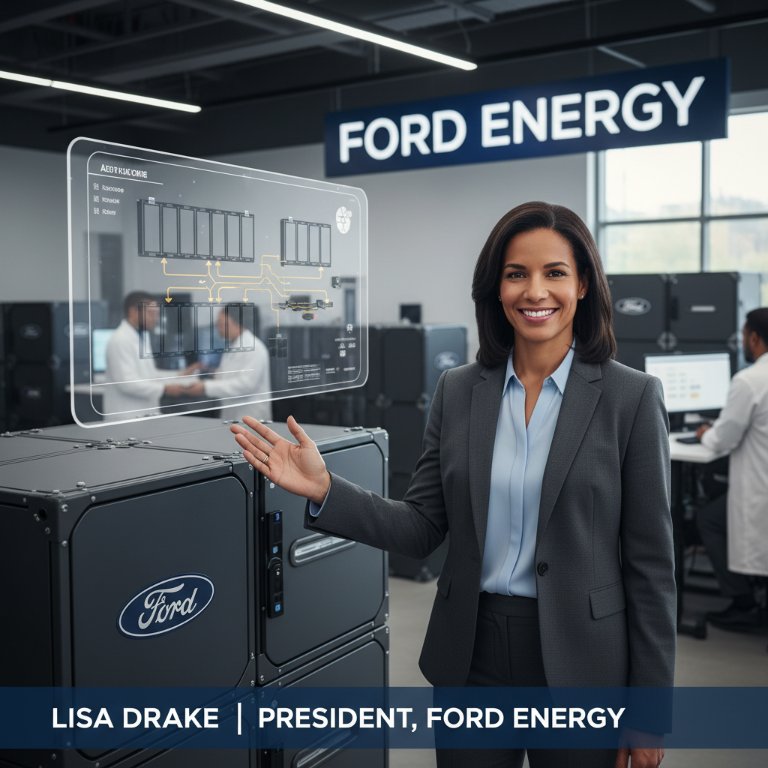
Ford Motor Company, a titan in the automotive world, is making a pivotal strategic move that extends its reach far beyond the garage. The company has announced the immediate appointment of Lisa Drake as president of Ford Energy, a newly formed division dedicated to launching and overseeing Ford’s ambitious battery energy storage systems (BESS) business. This isn't merely a new product line; it signals Ford's intent to become a significant player in the broader energy ecosystem, leveraging its rapidly expanding battery manufacturing prowess to address critical grid demands.
For years, Ford has been meticulously building out its electric vehicle (EV) capabilities, investing billions in battery research, development, and massive manufacturing facilities like those under the BlueOval SK joint venture. While the immediate focus has been powering the F-150 Lightning, Mustang Mach-E, and future EV models, industry observers have long pondered the broader implications of such significant battery investments. With Drake's appointment and the creation of Ford Energy, the 'why' and 'what's next' are becoming strikingly clear: Ford intends to monetize its battery expertise and production scale well beyond vehicle propulsion. This move positions Ford not just as an automaker, but as an integral provider of essential energy infrastructure.
Drake to Drive Ford's Entry into BESS
Lisa Drake steps into her new role with immediate effect, tasked with a formidable mission: establishing Ford's presence in the burgeoning BESS market. Her responsibilities will include:
- Strategic Direction: Defining the vision and roadmap for Ford Energy's BESS offerings.
- Market Penetration: Targeting utilities and large energy users, identifying their specific needs for reliable, scalable energy storage solutions.
- Operational Oversight: Building the necessary infrastructure, teams, and partnerships to execute on Ford's BESS strategy.
Ford Energy's core objective is to capitalize on the increasing demand for stationary battery storage, a critical component for grid stabilization, renewable energy integration, and ensuring energy resilience for industrial and commercial operations. The company will directly leverage its existing and planned battery manufacturing capabilities, initially developed for EVs, to create robust and reliable battery solutions for these new applications. This strategy is not just about producing more batteries; it's about maximizing the return on Ford's colossal investments in battery technology and production capacity, finding new avenues for revenue growth and market influence.
Why This Matters:
This strategic pivot by Ford carries profound implications for the automotive industry, the energy sector, and the broader transition to a sustainable future.
- Ford Wins Big: This move allows Ford to diversify its revenue streams significantly. By entering the BESS market, Ford can cushion itself against the cyclical nature of vehicle sales and create a more resilient business model. It also maximizes the utilization of its substantial battery factory investments, turning what was once a cost center primarily for vehicles into a potential profit center for the energy sector. This positions Ford as a holistic energy solutions provider, not just a vehicle manufacturer.
- Utilities and Large Energy Users Win: Ford's entry brings a major industrial player with significant manufacturing scale and engineering prowess into a market that desperately needs it. Utilities battling grid instability and the intermittency of renewable sources will gain a new, potentially massive, supplier of large-scale battery storage. Large enterprises can secure their energy supply, reduce peak demand charges, and integrate their own renewable generation more effectively.
- Competitors Face a Formidable New Foe: Established BESS providers, from startups to conglomerates, will now contend with a new player possessing deep pockets, global manufacturing expertise, and a trusted brand name. Ford's scale could drive down costs and accelerate innovation across the industry.
- A Signal to the Market: This announcement underscores the convergence of the automotive and energy sectors. It signals that battery technology, once almost exclusively tied to personal mobility, is now a fundamental component of global energy infrastructure. Ford is demonstrating a sophisticated understanding of how to leverage its core competencies to address pressing global challenges beyond its traditional scope.
Ford's foray into battery energy storage with Lisa Drake at the helm is a calculated and strategically astute move. It represents a bold expansion of its business model, transforming the company from a mere vehicle producer into a diversified energy solutions provider. As the world continues its rapid shift towards electrification, Ford is positioning itself to not only build the vehicles of tomorrow but also to power the grids that sustain them, marking a significant evolution for the century-old automaker. The coming years will reveal just how impactful this new division truly becomes, but the groundwork is now firmly laid for Ford to energize more than just the roads.