Ford Halts F-150 Lightning Production, Recharges EV Strategy with $19.5 Billion Restructuring
Ford Motor Company is executing a significant strategic pivot in its electric vehicle ambitions, recalibrating its aggressive electrification strategy...
Editorial Team
World Of EV
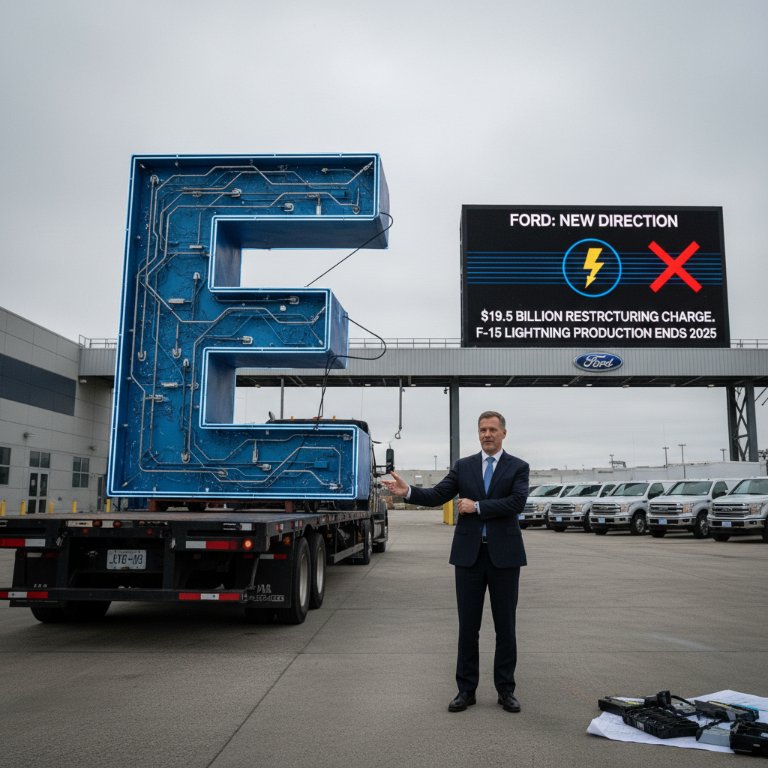
Ford Motor Company is executing a significant strategic pivot in its electric vehicle ambitions, recalibrating its aggressive electrification strategy amidst evolving market realities. CEO Jim Farley announced a profound shift, narrowing the company's focus to its enduring strengths: trucks, commercial vehicles, and carefully selected electrified models. This bold move includes the complete discontinuation of the current F-150 Lightning electric pickup production in 2025 and an enormous $19.5 billion charge tied to restructuring its dedicated electric vehicle business unit, Model e.
For years, Ford enthusiastically championed a rapid transition to an all-electric future, pouring billions into the development and production of a broad EV lineup. The F-150 Lightning, in particular, was hailed as a cornerstone of this strategy, leveraging the iconic F-Series nameplate to electrify the lucrative pickup truck segment. Its initial reception was strong, signaling Ford's serious intent to challenge traditional and emerging EV players. However, the market for EVs, particularly higher-priced models, has not matured as quickly or uniformly as many automakers, including Ford, initially anticipated.
The Strategic U-Turn: A Focus on Profitability
Ford's decision to scale back its ambitious pure EV plans is a direct response to customer demand and the challenging economics of the current EV market. Rather than chasing volume across every segment, the Blue Oval is now prioritizing profitability and leveraging its established leadership in key areas. This revised strategy will see Ford:
- Concentrate on core strengths: Heavy emphasis on traditional trucks, commercial vans through Ford Pro, and high-margin internal combustion engine (ICE) vehicles.
- Prioritize hybrids and Extended Range Electric Vehicles (EREVs): Ford will increase production of hybrid models and shift its next-generation F-150 Lightning to an EREV architecture, incorporating a gas-powered generator to recharge the battery.
- Invest in more affordable EV platforms: While pulling back on certain high-cost EVs, Ford plans to introduce new, cheaper battery electric vehicle (BEV) models.
The F-150 Lightning's Electric Sunset
Perhaps the most striking aspect of this recalibration is the discontinuation of the current-generation F-150 Lightning. This electric truck, once a beacon of Ford's EV future, will cease production after its 2025 models. This move starkly contrasts the initial hype and significant investment surrounding its launch. The company acknowledges that much of its EV lineup, especially those priced above $50,000, failed to achieve anticipated sales volumes, leading to a flatter adoption curve than projected. The shift reflects a difficult but necessary acknowledgment that the market for premium electric trucks is not yet robust enough to justify Ford's initial production forecasts and investment.
Model e's Painful Recalibration
The financial implications of this strategic shift are staggering, with Ford absorbing a $19.5 billion charge primarily related to the restructuring of its Model e division. This substantial write-down includes asset impairments and program write-downs for its EV assets and reflects the high costs and significant losses incurred by the division since its inception. Model e has reportedly lost over $13 billion in less than three years, including $3.6 billion in the first three quarters of 2025 alone. This charge underscores the immense financial challenges even established automakers face in achieving profitability in the rapidly evolving EV landscape. Ford now expects Model e to reach profitability by 2029, a significant delay from earlier projections.
Why This Matters:
For Ford: This is a crucial, perhaps 'do-or-die,' moment to stem the bleeding from its EV losses and solidify its financial foundation. By focusing on profitable segments and re-evaluating its EV rollout, Ford aims to create a stronger, more resilient, and profitable enterprise. It signals a shift from a 'growth at all costs' EV strategy to a more pragmatic, profit-driven approach. The raised 2025 operating profit guidance, despite the massive charge, suggests that this refocusing might already be yielding benefits for its overall financial health.
For the EV Market: Ford's pivot sends a clear signal that the initial gold rush mentality around EVs is over. The market is maturing, and profitability, not just production volume, is paramount. This move validates concerns about lukewarm consumer demand for certain high-cost EVs and the challenges of scaling production profitably. It might encourage other legacy automakers to reassess their own aggressive EV timelines and consider a more diversified portfolio, including hybrids and EREVs, as a bridge. This could also intensify competition in the more affordable EV segments, as companies like Ford seek viable paths to electrification.
For Consumers: Prospective F-150 Lightning buyers will be disappointed by the discontinuation of the current model, but the shift towards an EREV version suggests Ford isn't abandoning the electric truck concept entirely, simply refining its approach to meet practical consumer needs like range anxiety. Overall, consumers might see fewer pure EV options from Ford in the short term, but potentially more refined, cost-effective, and range-diverse electrified vehicles in the future, including a broader selection of hybrids.
For the Industry: This move could accelerate the industry's embrace of hybrid and EREV technologies as essential components of a broader electrification strategy, rather than solely focusing on pure battery electric vehicles. It also highlights the intense capital requirements and financial risks associated with the EV transition, serving as a cautionary tale for those rushing into the market without a clear path to profitability.
Ford's dramatic restructuring of its Model e division and the discontinuation of the F-150 Lightning production represent a stark awakening to the complexities of the EV transition. This isn't a retreat from electrification but a strategic recalibration, prioritizing financial health and market realism over aggressive, unyielding targets. The coming years will reveal whether this pivot provides Ford with the necessary agility to navigate the evolving automotive landscape and secure a profitable future in an increasingly electrified world.