Ford F-150 Lightning Battery Health Shakes Up EV Charging Dogma
For years, the golden rule of electric vehicle (EV) ownership has been clear: avoid charging to 100% daily, and certainly don't leave your battery sit...
Editorial Team
World Of EV
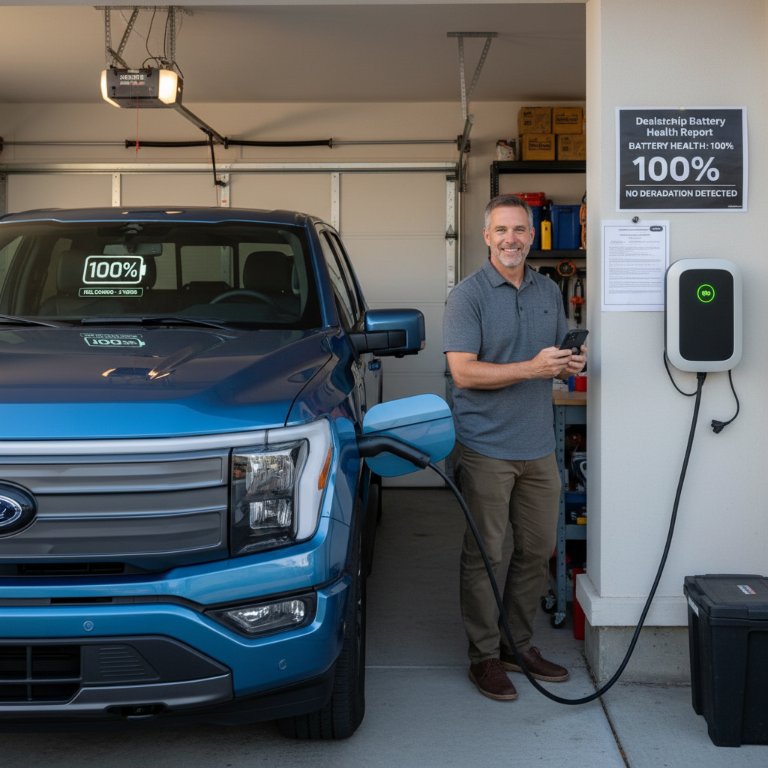
For years, the golden rule of electric vehicle (EV) ownership has been clear: avoid charging to 100% daily, and certainly don't leave your battery sitting at a full state of charge for extended periods. This conventional wisdom, aimed at preserving lithium-ion battery longevity, has shaped charging habits for countless EV owners. However, a recent report from a Ford F-150 Lightning owner on Reddit is challenging this long-held belief, offering compelling evidence that Ford's battery management system (BMS) might be far more robust than anticipated.
The owner's anecdote details a rigorous, arguably 'abusive,' charging regimen: plugging in their F-150 Lightning every night and consistently charging it to 100% for over two years, often leaving it at full capacity for extended durations. This practice directly contradicts nearly every piece of advice given to optimize battery health. Yet, when subjected to a dealership battery health test, the results were nothing short of astonishing: the battery still registered 100% health, showing no degradation whatsoever.
The Unconventional Regimen and Shocking Results
This F-150 Lightning owner didn't just push the boundaries; they seemingly ignored them entirely. Their daily routine involved:
- Consistent 100% Charging: Every night, for over two years, the truck was charged to its maximum capacity.
- Extended Full Charge Periods: The vehicle frequently remained at 100% charge for prolonged periods, a scenario generally considered detrimental to battery health.
- Zero Apparent Degradation: Despite this, a professional dealership diagnostic confirmed the battery was still operating at peak, 100% health, defying typical expectations of even minimal capacity loss over two years and thousands of charge cycles.
This outcome starkly contrasts with the experiences of many early EV adopters and even some modern EV owners who report noticeable degradation after similar periods, especially if not meticulously managing their charge cycles. It suggests a deeply engineered resilience within the F-150 Lightning's power architecture.
Why This Matters:
This single anecdotal report, while not a scientific study, carries significant weight and sends several powerful signals across the EV landscape.
- Boosts Consumer Confidence in Ford EVs: For prospective F-150 Lightning buyers, this news is a massive confidence booster. Battery degradation anxiety is a major hurdle for many considering an EV, and this directly addresses those fears, suggesting Ford's trucks can withstand real-world, less-than-ideal charging habits without suffering. It positions the F-150 Lightning as a truly robust workhorse, capable of enduring demanding usage without compromising its core performance.
- Validation of Ford's BMS and Thermal Management: The primary 'winner' here is Ford's engineering team. This report strongly implies that the F-150 Lightning's battery management system (BMS) and thermal management systems are exceptionally sophisticated and effective. These systems are designed to protect the battery, even when charged to 100%, by carefully balancing cells, managing temperatures, and potentially employing software 'buffers' that present a '100% charge' to the user while slightly reserving actual cell capacity for longevity. This engineering prowess allows owners to maximize usable range without guilt or complex charging strategies.
- Challenging the 'Don't Charge to 100%' Dogma: While the advice to avoid constant 100% charging remains generally sound for most lithium-ion chemistries, this specific case suggests that some modern EV platforms, particularly those designed for utility and rigorous use like the F-150 Lightning, may have sufficiently advanced systems to mitigate these risks. This could lead to a re-evaluation of general charging advice, at least for certain vehicles, empowering owners with greater flexibility.
- Market Implications for EV Trucks: As the EV truck segment heats up with competitors like the Chevrolet Silverado EV and Ram 1500 REV, battery durability and perceived longevity will be critical differentiators. Ford's F-150 Lightning, with this kind of real-world testament to its battery health, gains a significant competitive edge, appealing directly to truck owners who demand reliability and minimal fuss.
This F-150 Lightning owner's experience is a powerful testament to the advancements in EV battery technology and management. While it’s always prudent to follow manufacturer recommendations, this real-world data point provides compelling evidence that Ford's electric truck is engineered for impressive long-term battery resilience, allowing owners to charge without undue worry and truly utilize their vehicle's full range. This development could reshape consumer perceptions of EV battery longevity and further solidify the F-150 Lightning's position as a leader in the nascent electric truck market.