Ford and Xiaomi Flatly Deny US EV Manufacturing Talks: A Strategic Divergence in a Tense Climate
Reports from the Financial Times alleging preliminary discussions between Ford Motor Company and Chinese tech giant Xiaomi for a potential electric ve...
Editorial Team
World Of EV
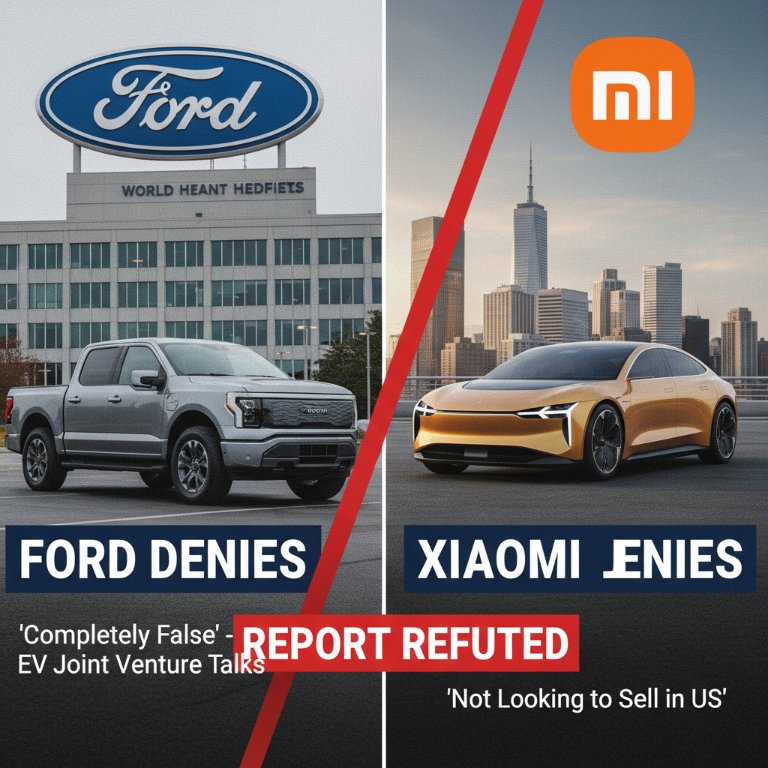
Reports from the Financial Times alleging preliminary discussions between Ford Motor Company and Chinese tech giant Xiaomi for a potential electric vehicle (EV) manufacturing joint venture in the United States have been unequivocally shut down by both companies. This swift and direct denial sends a clear message about the current strategic priorities and geopolitical realities facing the global automotive industry.
In a highly competitive EV landscape, where traditional automakers grapple with software integration and speed-to-market challenges, and tech firms eye lucrative automotive expansion, such a partnership could have been transformative. However, both Ford and Xiaomi have moved decisively to quell speculation, with Ford labeling the report 'completely false,' and Xiaomi stating it holds no ambition to sell or build cars in America.
The Reports and Resolute Rebuttals
The Financial Times' report, which emerged recently, suggested that both automotive giant Ford and smartphone-turned-EV-maker Xiaomi had engaged in early-stage talks regarding a joint manufacturing operation within the United States. Such an alliance would have marked a significant cross-cultural and cross-industry collaboration, potentially leveraging Ford's manufacturing prowess and Xiaomi's cutting-edge technology and software capabilities.
However, the denials were immediate and unambiguous:
- Ford's Stance: A spokesperson for Ford declared the report 'completely false,' leaving no room for interpretation regarding the company's involvement in such discussions.
- Xiaomi's Position: The Chinese tech powerhouse, fresh off the successful launch of its SU7 EV in its home market, firmly stated that it is 'not looking to sell or build cars in America.' This aligns with Xiaomi's current strategy, which has heavily focused on consolidating its position in the intensely competitive Chinese EV market.
Critical Context: Navigating a Complex Global EV Landscape
Ford has aggressively pursued its own multi-billion-dollar EV strategy, committing substantial investments to North American manufacturing, including the massive BlueOval City campus in Tennessee and new battery plants through its partnership with SK On. The company aims for significant EV production capacity in the US, leveraging domestic supply chains to benefit from incentives like the Inflation Reduction Act (IRA).
On the other side, Xiaomi's entry into the EV market with the SU7 has been nothing short of spectacular in China. The company has demonstrated a rapid ability to integrate advanced technology, particularly in infotainment and autonomous driving features, into its vehicles. Its primary focus, however, has been on capturing market share within its home turf, where it competes fiercely with established players like BYD and rising stars like Nio and Xpeng.
Why This Matters:
The swift denials from both Ford and Xiaomi carry significant implications for the global EV market and underscore the complexities of international partnerships in the current geopolitical climate:
- Geopolitical Hurdles Remain Paramount: The most critical takeaway is the implicit acknowledgment of the severe political and economic friction between the US and China. With mounting tariffs on Chinese-made EVs entering the US and increasing scrutiny of Chinese technology, a direct manufacturing joint venture on US soil would face immense political and regulatory headwinds. This denial signals that such a partnership is currently unfeasible, regardless of potential technical synergies.
- Ford's Independent North American Path: Ford appears committed to its established, independent strategy for EV manufacturing and supply chains in North America. Integrating a Chinese tech partner, especially one with rapidly developing automotive IP, could complicate existing alliances and its brand identity in a fiercely patriotic market. Ford needs to maintain clear control over its narrative and manufacturing destiny in its home market.
- Xiaomi's Domestic Dominance Strategy: Xiaomi's statement reinforces its current laser focus on the massive and highly competitive Chinese EV market. While global ambitions are likely on the horizon, expanding into the US – with its unique regulatory environment, distribution challenges, and protectionist sentiments – would be a gargantuan undertaking. Prioritizing success at home is a pragmatic approach.
- Lost Opportunity for Synergies (For Now): While politically difficult, a Ford-Xiaomi partnership could have offered compelling benefits. Ford could gain rapid access to Xiaomi's software prowess and aggressive tech integration cycles, while Xiaomi could leverage Ford's deep manufacturing expertise and established dealer networks. For now, both companies are pursuing their respective strategies independently, potentially missing out on accelerated innovation that a collaborative effort might bring.
- Market Signal of Caution: The explicit denials serve as a strong signal to the market that despite the allure of cross-border and cross-industry collaborations, the current geopolitical environment makes such endeavors, particularly between US and Chinese entities in strategic sectors like automotive, exceptionally challenging.
In conclusion, the resounding denials from Ford and Xiaomi effectively close the door on a potential US EV manufacturing joint venture for the foreseeable future. This outcome reflects not just individual corporate strategies but also the formidable political and economic barriers that continue to shape the global automotive industry, particularly concerning US-China collaborations. Both companies will continue their independent paths, navigating a fragmented yet rapidly evolving EV landscape, with the geopolitical backdrop remaining a critical determinant of future partnerships and market entries.