EV Readiness Under Fire: Petrol Generator Saves Tata Harrier.ev in High-Altitude Ordeal
A recent incident in India's remote and high-altitude Spiti Valley has ignited crucial conversations among EV enthusiasts and industry experts alike. ...
Editorial Team
World Of EV
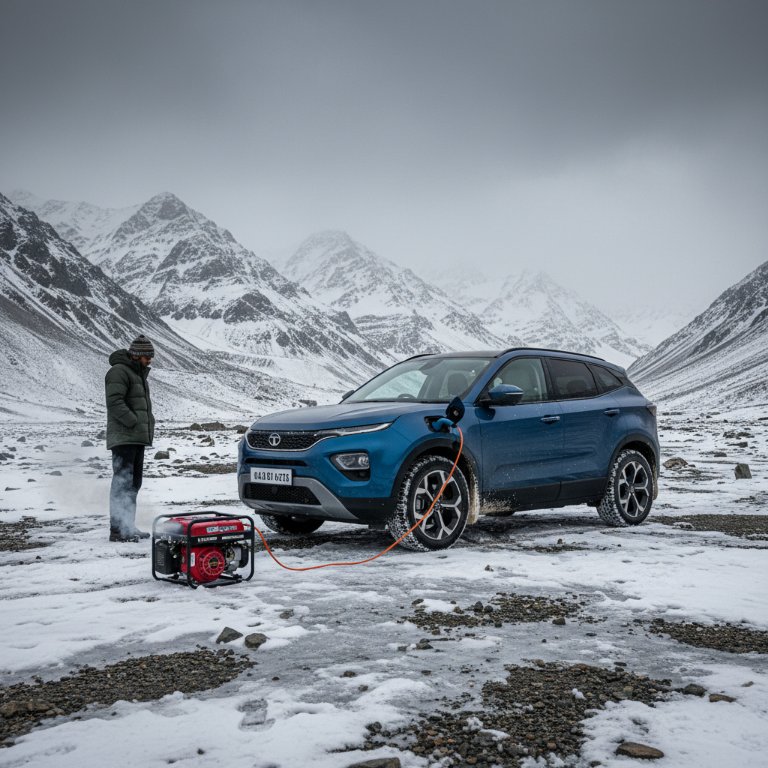
A recent incident in India's remote and high-altitude Spiti Valley has ignited crucial conversations among EV enthusiasts and industry experts alike. Faced with freezing temperatures and a complete absence of public charging infrastructure, a resourceful Tata Harrier.ev owner resorted to an unconventional solution: using a petrol generator to trickle charge their electric SUV via its AC port. This workaround, while seemingly contradictory to the ethos of electric mobility, allowed the owner to prevent stranding and safely extend their vehicle's range in extremely challenging terrain. The event has sparked widespread online discussion, forcing a candid re-evaluation of real-world EV readiness in remote regions.
India, a burgeoning automotive market, has seen a rapid push towards electrification, with homegrown giant Tata Motors leading the charge. Tata has aggressively expanded its EV portfolio, positioning itself as the largest player in India's rapidly growing EV space and aiming for significant market penetration by 2030. However, the Spiti Valley episode underscores the stark contrast between urban EV adoption narratives and the challenging realities of remote, rugged geographies.
The Spiti Ordeal: A Glimpse into Extreme EV Ownership
Spiti Valley, nestled in the Himalayas, is renowned for its breathtaking landscapes but also its brutal winters, where temperatures can plummet to -20°C or even -30°C at night. Roads are often covered in snow, and basic amenities, including reliable power and modern infrastructure, are scarce. It's a region where diesel vehicles traditionally dominate due to their perceived robustness and simpler fueling logistics in extreme conditions.
The Tata Harrier.ev, a prominent electric SUV from Tata Motors, comes with battery options up to 75 kWh, promising an ARAI-certified range of over 600 km, with a real-world range around 400-505 km for the 75 kWh variant. It is equipped with features like a dual-motor setup for Quad Wheel Drive (QWD), boosting its off-road credentials. However, even with such capabilities, the lack of charging stations in an unforgiving environment like Spiti rendered its electric powertrain vulnerable.
In a move that quickly went viral, the owner connected their Harrier.ev to a petrol generator through its standard AC charging port. This 'trickle charge' method, though slow and inefficient in sub-zero temperatures, provided enough supplemental power to prevent the vehicle from being completely immobilized. This pragmatic decision allowed the journey to continue, highlighting both the limitations of current EV infrastructure and the ingenuity of EV owners when pushed to the brink.
Why This Matters:
- The Unaddressed Infrastructure Gap: Despite India's rapid expansion of public EV charging points—from 1,800 in early 2022 to over 16,000 by March 2024, and exceeding 30,000 public stations more recently—the concentration remains heavily urban. Remote and high-altitude regions like Spiti Valley are largely neglected, exposing a significant chasm between policy ambitions and on-the-ground reality. This lack of reliable charging infrastructure creates a new dimension of "range anxiety" for adventurers and residents in challenging terrains.
- OEM Accountability and Innovation: While Tata Motors has invested heavily in EV development and expanding its proprietary charging network (Tata Power aims to install over 10,000 public charging points), this event signals that manufacturers must consider extreme use cases beyond typical urban and highway corridors. The incident might spur innovation in auxiliary power solutions for EVs, such as integrated small-scale range extenders, vehicle-to-load (V2L) capabilities for external charging (which the Harrier.ev already supports to some extent), or even more robust portable charging solutions specifically designed for remote operations.
- The 'Green' Paradox and Pragmatism: The use of a petrol generator to charge an an EV understandably sparks debate about the 'green' credentials of electric vehicles, as it involves burning fossil fuel. However, this isn't a failure of the EV itself but a testament to human adaptability in adverse conditions. For an EV owner facing being stranded in life-threatening cold, pragmatism trumps idealism. This incident forces a nuanced view: while the ideal is 100% renewable charging, real-world scenarios sometimes demand temporary, less-than-ideal solutions to ensure safety and mobility.
- Policy Implications for Remote Connectivity: Governments and policymakers, particularly in diverse countries like India, need to broaden their infrastructure strategies. Mandates for charging stations every 20 km on highways are a start, but remote tourist destinations and critical transit points in challenging geographies require dedicated, resilient solutions. This might involve subsidized off-grid charging solutions, collaborations with local communities, or incentivizing robust, all-weather charging hubs.
Ultimately, the Spiti Valley incident with the Tata Harrier.ev isn't a condemnation of electric vehicles, but a critical learning moment for their broader integration. It highlights that while the technology is advancing rapidly, the ecosystem supporting it—especially in extreme environments—still has significant ground to cover. The future of EV adoption hinges not just on impressive specs and competitive pricing, but on truly ubiquitous, reliable, and resilient charging infrastructure that can support electric mobility in every corner of the world, no matter how remote or challenging.