EV Ownership Hits Unprecedented Satisfaction Levels: A Turning Point for the Mainstream Market
The electric vehicle (EV) revolution has reached a pivotal moment, as the J.D. Power 2026 U.S. Electric Vehicle Experience (EVX) Ownership Study revea...
Editorial Team
World Of EV
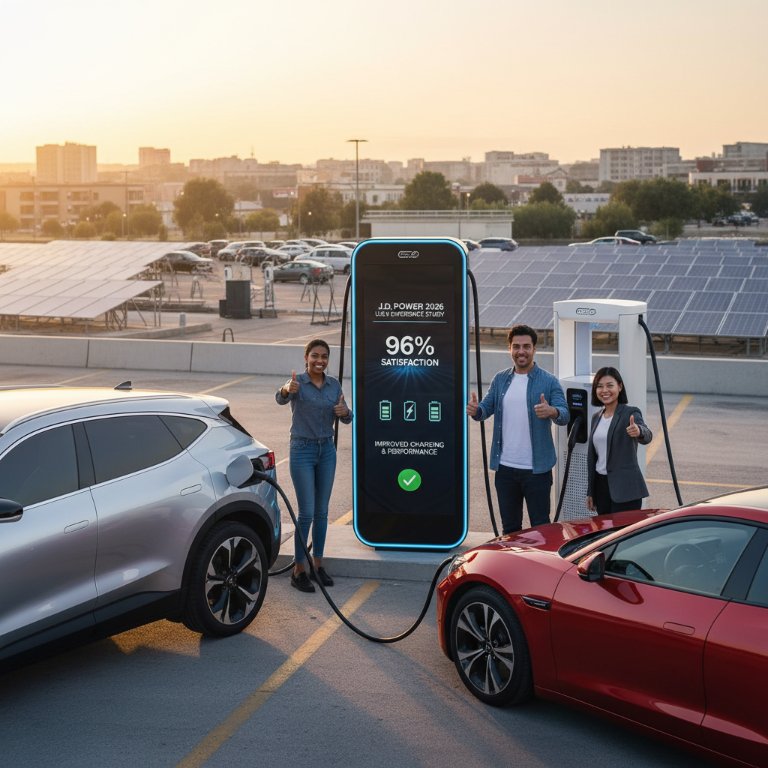
The electric vehicle (EV) revolution has reached a pivotal moment, as the J.D. Power 2026 U.S. Electric Vehicle Experience (EVX) Ownership Study reveals overall satisfaction among battery electric vehicle (BEV) owners has soared to its highest level since the study's inception in 2021. This isn't merely an uptick; it's a resounding endorsement, with a significant 96% of new BEV owners expressing their intent to purchase or lease another EV for their next vehicle.
After years of navigating nascent technology and evolving infrastructure, the EV market is unequivocally maturing. This surge in owner satisfaction directly addresses lingering concerns that once shadowed early adoption, signaling a confident stride toward widespread mainstream acceptance.
The Pillars of Proprietor Pleasure: What's Driving Record Satisfaction
Several critical advancements are coalescing to create this elevated ownership experience, according to the comprehensive J.D. Power study.
- Advanced Battery Technology: Continuous improvements in battery chemistry and management systems translate to longer ranges and often faster charging capabilities, directly mitigating the pervasive 'range anxiety' that historically deterred prospective buyers.
- Robust Overall Vehicle Performance: EVs consistently deliver instant torque, quiet operation, and a smooth driving experience, factors that contribute significantly to owner enjoyment.
- Expansive Charging Infrastructure: The landscape of public charging has undergone a dramatic transformation. Satisfaction with public charging has climbed to new highs across both premium and mass-market segments.
- Crucially, Tesla Supercharger Network Access: The opening of the industry-leading Tesla Supercharger network to non-Tesla EVs has been a 'game-changer,' significantly improving satisfaction among mass market BEV owners. This widespread access to one of the most reliable and extensive fast-charging networks in North America instills immense confidence in drivers, even with some initial logistical challenges like cable length for non-Tesla vehicles.
Beyond the Pump: The Economic Edge of EV Ownership
Beyond technological and experiential factors, the practical economics of EV ownership are also playing a substantial role in this record satisfaction.
- Less Routine Maintenance Required: EVs possess significantly fewer moving parts than their internal combustion engine (ICE) counterparts, eliminating the need for oil changes, spark plug replacements, and complex exhaust system repairs.
- Average Maintenance Costs 30-40% Lower: This reduced complexity translates into tangible financial savings, with maintenance being 30-40% cheaper on average compared to gasoline vehicles.
- Direct Financial Benefit: Over the lifespan of a vehicle, these savings add up to hundreds, if not thousands, of dollars annually, addressing a key consumer concern about the total cost of ownership.
Why This Matters:
This J.D. Power study isn't just good news; it's a critical validation of the entire EV ecosystem. It signifies that the early hurdles—range limitations, charging anxieties, and initial cost perceptions—are being systematically overcome, moving EVs from a niche product for early adopters to a compelling choice for the broader public. The 96% repurchase intent is arguably the most powerful metric, demonstrating that once consumers experience an EV, they rarely look back.
Who Wins? Consumers, first and foremost, are winning with better, more reliable, and more economically sensible vehicles. EV manufacturers who invested heavily in battery technology, vehicle performance, and collaborative charging solutions (like adopting NACS) are seeing their strategies validated. Charging infrastructure providers also benefit from increased utilization and the justification for further expansion. The environment, of course, stands to gain as adoption accelerates.
Who Loses? Legacy internal combustion engine (ICE) manufacturers who have been slow or reluctant to pivot fully to electrification face an increasingly challenging future. As EV satisfaction solidifies, the appeal of traditional gasoline vehicles diminishes. Skeptics and purveyors of 'FUD' (fear, uncertainty, and doubt) surrounding EVs find their arguments increasingly undermined by real-world owner experiences.
What Does This Signal to the Market? This study is a clear market signal: the 'tipping point' for mass EV adoption is not a distant future concept, but an accelerating reality. It underscores the urgency for all industry players—automakers, charging companies, and policymakers—to double down on investments in EV development, infrastructure build-out, and consumer education. The market is ready; the product is increasingly refined; and the experience is overwhelmingly positive. This is a crucial moment for the industry to capitalize on this positive momentum and cement EVs as the dominant powertrain of the future.
The J.D. Power 2026 EVX Ownership Study paints a clear picture: electric vehicle ownership has matured into a highly satisfying and economically advantageous proposition. With soaring owner satisfaction and an overwhelming intent to remain electric, the future of personal transportation is not merely leaning electric; it is confidently embracing it. Expect continued innovation, even more robust infrastructure, and a sustained push for consumer education to further solidify this trajectory in the years ahead.