EV Home Charging Satisfaction Plummets Amid Rising Costs and Critical Education Gap, JD Power Study Reveals
The promise of convenient, cost-effective home charging, a cornerstone of electric vehicle ownership, is showing cracks. According to the recently rel...
Editorial Team
World Of EV
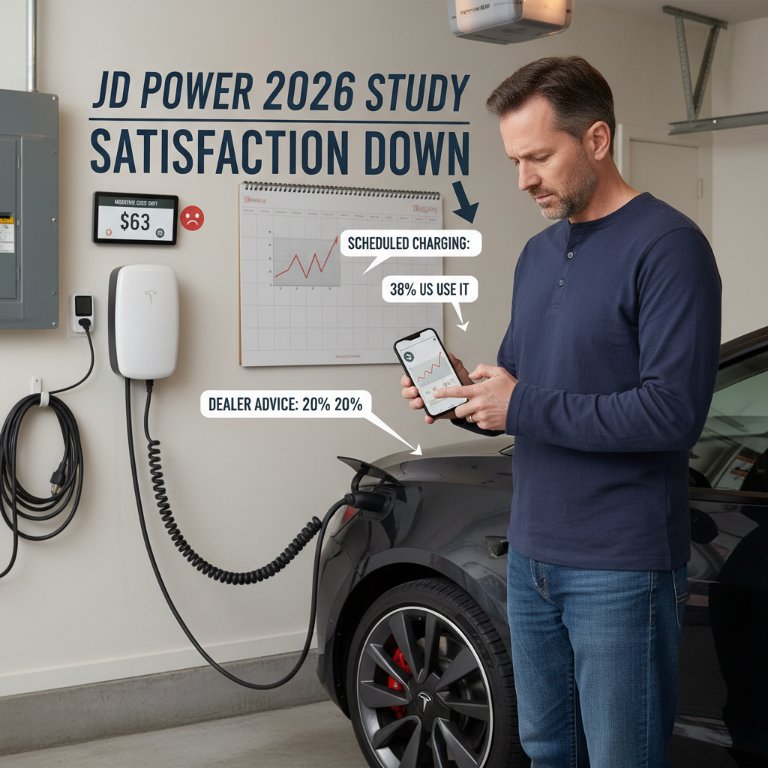
The promise of convenient, cost-effective home charging, a cornerstone of electric vehicle ownership, is showing cracks. According to the recently released J.D. Power 2026 U.S. Electric Vehicle Experience (EVX) Home Charging Study, overall satisfaction among EV owners is on a concerning decline, driven by escalating costs and a glaring lack of essential education from dealerships. This trend threatens to temper the enthusiasm of prospective buyers and highlights a critical industry oversight, even as Tesla continues its unchallenged reign in permanently mounted Level 2 charging.
For years, the convenience of waking up to a 'full tank' has been a significant draw for EV adopters. However, the latest data paints a more complex picture. Satisfaction with Level 1 portable chargers—often included with the vehicle and representing the slowest charging option—has dipped to 569 on a 1,000-point scale, a 12-point drop from the previous year. Level 2 portable chargers, offering faster charging with more flexibility, also saw a decline, albeit a smaller one, falling 4 points to 710. In stark contrast, satisfaction with Level 2 permanently mounted home chargers, the gold standard for dedicated home charging, held steady at 733. This divergence underscores a growing preference for robust, dedicated charging solutions over more temporary or slower alternatives.
The Price of Convenience: Cost and Charger Type Divergence
The most significant driver of this dip in satisfaction appears to be the rising cost of electricity. The average amount spent on EV home charging in the past 30 days climbed to $63, a $5 increase from a year ago. This incremental but consistent rise has directly correlated with a noticeable dip in satisfaction related to charging costs. For many EV owners, the financial savings compared to gasoline have been a key motivator, and any erosion of that advantage can lead to buyer's remorse. This increase comes at a time when utility rates are fluctuating, and without proper guidance, owners may not be optimizing their charging habits for cost efficiency.
Dealers Fail the First Mile: A Missed Opportunity in Home Charging Guidance
Compounding the issue of rising costs is an alarming deficiency in dealer education. The study reveals that a mere 20% of EV owners received any education or advice on home charging from their purchasing dealer. This is a critical oversight, as proper charging habits, particularly scheduled charging, are proven to boost satisfaction and significantly lower costs by utilizing off-peak electricity rates. Despite its clear benefits, only 38% of EV owners consistently use scheduled charging. This gap represents a massive missed opportunity for dealerships to empower their customers, enhance the ownership experience, and solidify the long-term value proposition of an EV. Without this foundational knowledge, many owners are likely defaulting to immediate charging, regardless of cost, leading to unnecessary expenses and growing frustration.
Tesla Maintains Dominance in Dedicated Home Charging
Amidst these challenges, one player consistently stands out: Tesla. For the sixth consecutive year, Tesla ranks highest for Level 2 permanently mounted charging stations. This ongoing leadership is a testament to Tesla's integrated ecosystem approach, which extends beyond just the vehicle to include a robust charging infrastructure and user-friendly home charging solutions. Tesla's ability to consistently deliver a superior home charging experience, year after year, showcases the benefits of vertical integration and a strong focus on the entire customer journey, setting a high bar for competitors.
Why This Matters:
This J.D. Power study serves as a critical barometer for the health of the EV adoption curve. The declining satisfaction, particularly linked to costs and the lack of foundational knowledge, signals potential headwinds if not addressed swiftly. Who Wins? Tesla, undoubtedly, continues to demonstrate the power of a cohesive, high-quality product and service ecosystem, from vehicle to home charging. Owners who invest in permanently mounted Level 2 chargers and proactively seek out smart charging practices also come out ahead. Who Loses? The broader EV market, if these trends persist. New and prospective EV owners, unprepared for charging realities and potential cost increases, may face disillusionment. Dealers are demonstrably losing a vital opportunity to build customer loyalty and ensure a positive post-purchase experience. This is not just about selling a car; it's about selling an entire lifestyle, and dealers are failing to onboard customers effectively into the charging aspect of that lifestyle. What Does This Signal to the Market? This is a wake-up call for the entire automotive industry. It highlights that as EVs transition from early adopters to the mainstream, the expectation for a seamless, cost-effective, and well-supported ownership experience dramatically increases. Automakers must pressure their dealer networks to provide comprehensive charging education, potentially integrating it into the sales process. Furthermore, it underscores the need for more intuitive and integrated smart charging solutions, perhaps even subsidized or bundled with vehicle purchases, to simplify the process for owners and maximize savings.
The findings from the 2026 EVX Home Charging Study underscore an urgent need for the EV industry to recalibrate its approach to customer education and support. As EV adoption accelerates, ensuring a positive and affordable home charging experience will be paramount to sustaining growth and realizing the full potential of electric mobility. Neglecting this crucial aspect risks transforming a key EV advantage into a source of frustration, slowing the very progress the industry strives to achieve.