Europe on the Brink: Tesla's FSD Poised for Landmark Regulatory Approval, Reshaping the Continent's EV Landscape
February 2026 looms as a monumental deadline for Tesla and the future of autonomous driving in Europe. The Dutch vehicle authority (RDW), a pivotal ga...
Editorial Team
World Of EV
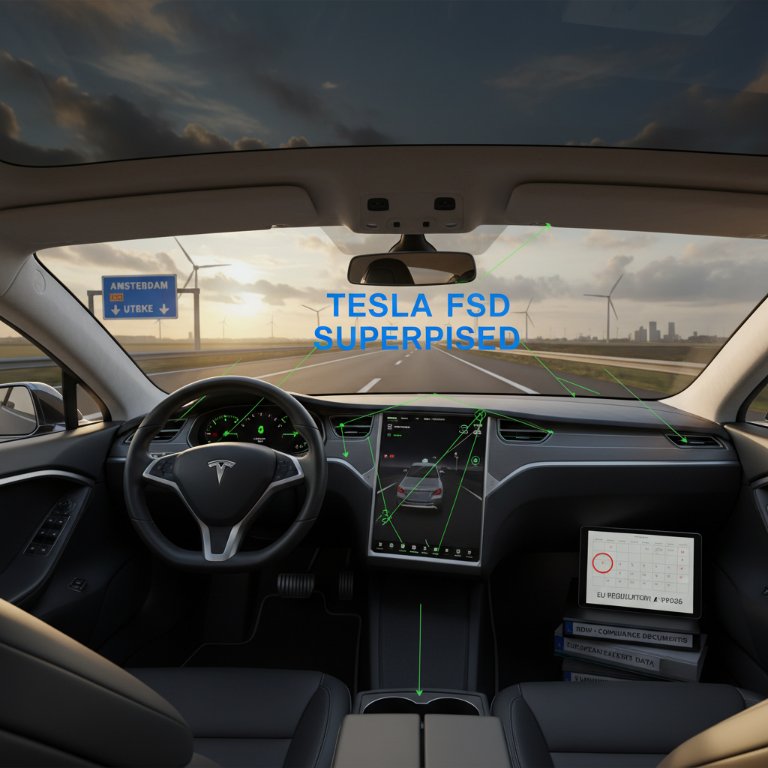
February 2026 looms as a monumental deadline for Tesla and the future of autonomous driving in Europe. The Dutch vehicle authority (RDW), a pivotal gatekeeper for type approval across the European Union, has set this critical target for Tesla to demonstrate that its Full Self-Driving (FSD) Supervised system adheres to the continent's stringent safety and compliance benchmarks. This long-awaited potential breakthrough, widely discussed in January 2026 industry reports, could unlock advanced autonomous capabilities for millions of European Tesla owners through the principle of mutual recognition across EU member states.
The Regulatory Gauntlet: RDW and European Standards
For years, European regulators have approached autonomous driving technologies with a cautious, methodical hand, prioritizing safety and driver attentiveness above all else. This contrasts sharply with some North American deployments. The RDW's role as the primary approval body is significant; their endorsement serves as a passport for FSD across the entire EU. This isn't merely a rubber stamp; it demands rigorous validation against a complex web of regulations that often exceed those found in other major markets. Tesla’s ability to navigate this regulatory maze will set a precedent for other autonomous driving systems aiming for a European rollout.
Tesla's Data Advantage: A Million Kilometers of Proof
To meet these exacting standards, Tesla has marshaled an impressive dataset. The company has meticulously compiled over 1 million kilometers of internal testing data, gathered across 17 diverse European countries. This extensive real-world driving experience is designed to address specific European road conditions, signage, and driver behaviors, providing the RDW with concrete evidence of FSD Supervised’s performance and safety protocols. This commitment underscores the immense investment Tesla has made to tailor its technology for the unique demands of the European market, moving beyond a one-size-fits-all approach.
Why This Matters:
- For Tesla: Regulatory approval of FSD Supervised in Europe would be an unprecedented triumph. It not only validates years of research and development but also opens a massive new revenue stream in a crucial market. This strategic win would significantly strengthen Tesla's competitive advantage, particularly as traditional automakers and other tech giants race to deploy their own advanced driver-assistance systems (ADAS) in the region. It’s a powerful statement of technological leadership and a potential catalyst for increased vehicle sales as FSD becomes a tangible, accessible feature for European buyers.
- For European EV Owners: This milestone means access to a level of autonomous driving previously unavailable. While FSD Supervised still requires driver oversight, it promises enhanced convenience, reduced driving fatigue, and potentially improved safety through its advanced predictive capabilities. It transforms the ownership experience, positioning Tesla owners at the forefront of automotive technology on the continent.
- For the Broader Automotive Industry: A successful FSD rollout in Europe puts immense pressure on every other automaker. Competitors must now accelerate their own autonomous driving development and regulatory compliance efforts, knowing that a significant player has cleared a major hurdle. This could spark a new wave of innovation and investment in ADAS technologies across the industry, particularly in areas like sensor fusion, AI-driven prediction, and robust safety redundancies. It signals that the era of truly advanced, commercially available autonomous features is no longer a distant dream but an imminent reality.
- Market Signal: This move underscores a critical shift: regulatory bodies are increasingly willing to engage with and certify sophisticated autonomous systems, provided they meet rigorous safety criteria. It sets a benchmark for what is acceptable in a highly regulated market, potentially streamlining future approvals for other companies that can demonstrate similar levels of safety and performance.
If Tesla secures RDW approval by February 2026, it will mark a pivotal moment, not just for the company, but for the entire trajectory of autonomous mobility in Europe. The continent, often seen as a challenging regulatory landscape, could soon embrace a new era of driving, with Tesla leading the charge. The industry watches with bated breath to see if this ambitious timeline will transform vision into widespread reality.