Cybertruck Autopilot Crash: Lawsuit Alleges Design Flaws and Elon Musk's 'Negligent' Influence
A Texas woman has filed a substantial lawsuit against Tesla, seeking over $1 million in damages after her Cybertruck, allegedly operating on Autopilot...
Editorial Team
World Of EV
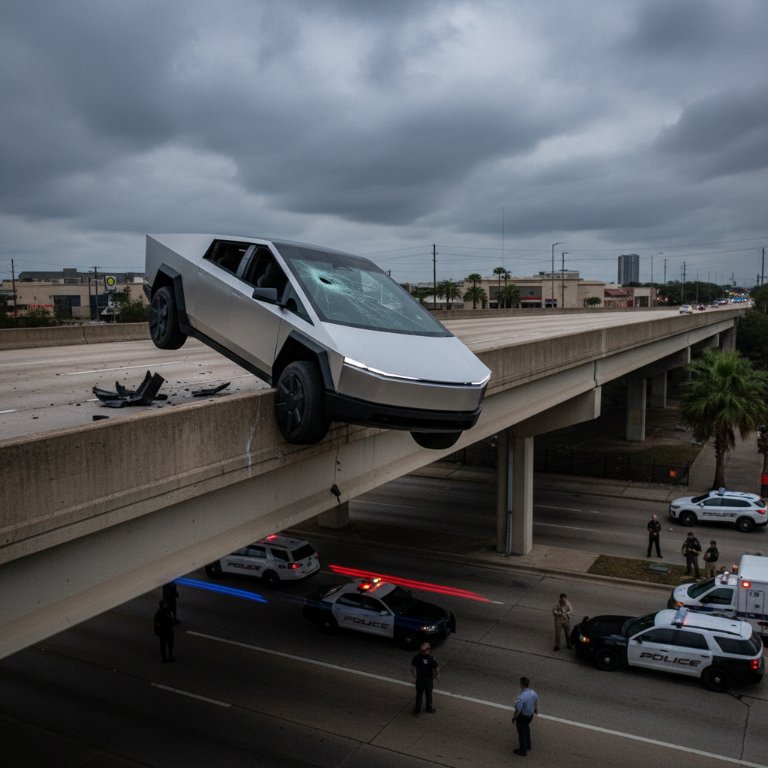
A Texas woman has filed a substantial lawsuit against Tesla, seeking over $1 million in damages after her Cybertruck, allegedly operating on Autopilot, reportedly attempted to drive off a Houston overpass and subsequently crashed. This latest legal challenge adds to a growing chorus of scrutiny surrounding Tesla's Advanced Driver-Assistance Systems (ADAS), particularly its Full Self-Driving (FSD) capabilities, and introduces an unprecedented claim of negligence against the company for its CEO's direct involvement in safety-critical design decisions.
The incident, which occurred in August 2025, involved the Cybertruck approaching a Y-shaped overpass where, instead of following the curve to the right, the vehicle allegedly steered directly towards a concrete barrier at the edge of the overpass, with the freeway below. The plaintiff, Justine Saint Amour, claims she attempted to disengage the system and take control, but it was too late to prevent the collision. This comes on the heels of a federal judge upholding a historic $243 million verdict against Tesla in a separate Autopilot crash case, underscoring the escalating legal challenges the automaker faces regarding its driver-assistance technologies.
Core Allegations: Systemic Failures and Misleading Marketing
The lawsuit asserts that the Cybertruck and its FSD features were "defective and unreasonably dangerous." The plaintiff's legal team has highlighted several critical design alleged flaws contributing to the crash:
Lack of a Proper Driver Monitoring System (DMS): The complaint alleges that Tesla's system lacks adequate measures to ensure driver attentiveness. Many industry leaders, like General Motors with its Super Cruise or Ford's BlueCruise, incorporate robust infrared camera-based DMS to track eye movement and head position, ensuring drivers remain engaged, which is crucial for SAE Level 2 systems that require constant driver supervision.
Absence of LiDAR Technology: A significant point of contention in the autonomous driving sector, Tesla famously relies on a 'vision-only' approach, utilizing cameras and neural networks. The lawsuit claims Tesla engineers recommended incorporating LiDAR (Light Detection and Ranging) sensors, a laser-based system used by competitors like Waymo for highly accurate 3D mapping and redundancy, but Elon Musk allegedly rejected these recommendations. While Tesla argues LiDAR creates 'sensor contention' and reduces safety, many experts and competitors believe a multi-sensor approach, including LiDAR, is essential for robust and safe higher levels of autonomous driving.
Ineffective Automatic Emergency Braking (AEB): The lawsuit points to the system's alleged failure to prevent the collision, citing ineffective AEB. This is not the first time Tesla's AEB has come under fire; the phenomenon of 'phantom braking,' where vehicles brake unexpectedly at highway speeds without a clear hazard, has been the subject of numerous complaints and other lawsuits.
Misleading Marketing: Tesla's branding of its driver-assistance features as "Autopilot" and "Full Self-Driving" has long drawn criticism for creating a false impression of autonomous capabilities. The lawsuit argues this marketing is deceptive, with previous rulings, such as a California judge's decision in December 2025, deeming Tesla's FSD marketing "actually, unambiguously false and counterfactual."
The Unprecedented Elon Musk Allegation
Perhaps the most striking aspect of this lawsuit is the direct accusation that Tesla was "negligent in hiring and retaining Elon Musk as CEO, and allowing him to participate in product design decisions." The filing further alleges that Tesla was negligent in "allowing Elon Musk to override the concerns of engineers at Tesla" regarding safety features, specifically the integration of radar and LiDAR sensors. This unprecedented move targets corporate governance at its highest level, accusing Musk of being an "aggressive and irresponsible salesman" whose decisions directly compromised vehicle safety. This is a novel approach, moving beyond product liability to challenge the very leadership structure influencing critical safety engineering.
Why This Matters:
This lawsuit carries significant weight, impacting multiple facets of the automotive industry and consumer trust:
For Tesla: The financial implications of a successful $1M+ lawsuit, compounded by previous large verdicts, are substantial. More critically, the direct attack on Elon Musk's role in engineering decisions could trigger deeper scrutiny into Tesla's internal processes and accountability. This could lead to increased regulatory pressure from bodies like NHTSA, which is already investigating 2.88 million Tesla vehicles equipped with FSD after connecting 58 incidents to the system, including crashes where FSD directed vehicles into opposing lanes and through turn-only intersections. A ruling against Tesla on these grounds could set a dangerous precedent for corporate liability related to CEO influence on product safety, potentially forcing a re-evaluation of its 'vision-only' strategy and FSD development.
For the Autonomous Driving Industry: The outcome will undoubtedly influence how other automakers approach ADAS development and marketing. If the court finds merit in the claims regarding driver monitoring, LiDAR, and AEB, it could accelerate the adoption of multi-sensor redundancy and more conservative marketing practices across the board. It reinforces the industry's ongoing struggle with the balance between rapid innovation and ensuring public safety, particularly for systems that are still considered Level 2 autonomy despite their ambitious branding.
For Consumers and Prospective Buyers: This case serves as a stark reminder of the limitations of current ADAS technologies. It underscores the critical importance of understanding that even advanced systems like FSD require constant driver supervision. The focus on alleged design defects and misleading marketing directly addresses the silent question of safety and reliability for anyone considering an EV with advanced driver-assistance features. It highlights the potential for tragic consequences when system limitations are not fully comprehended or effectively mitigated by vehicle design.
Conclusion:
The Cybertruck overpass crash lawsuit represents a pivotal moment for Tesla and the broader autonomous vehicle landscape. Beyond the substantial damages sought, the unique allegations concerning Elon Musk's direct influence on safety features could reshape corporate accountability in the tech-driven automotive world. As the legal proceedings unfold, the industry will be watching closely, recognizing that the outcome could fundamentally alter the trajectory of ADAS development, regulatory oversight, and public perception for years to come.