Cramer Crowns Tesla a Robotics Titan: A Paradigm Shift Reshapes the EV Giant's Future
Wall Street has a new perspective on an old titan. Veteran analyst Jim Cramer recently delivered a bombshell assessment: Tesla should no longer be vie...
Editorial Team
World Of EV
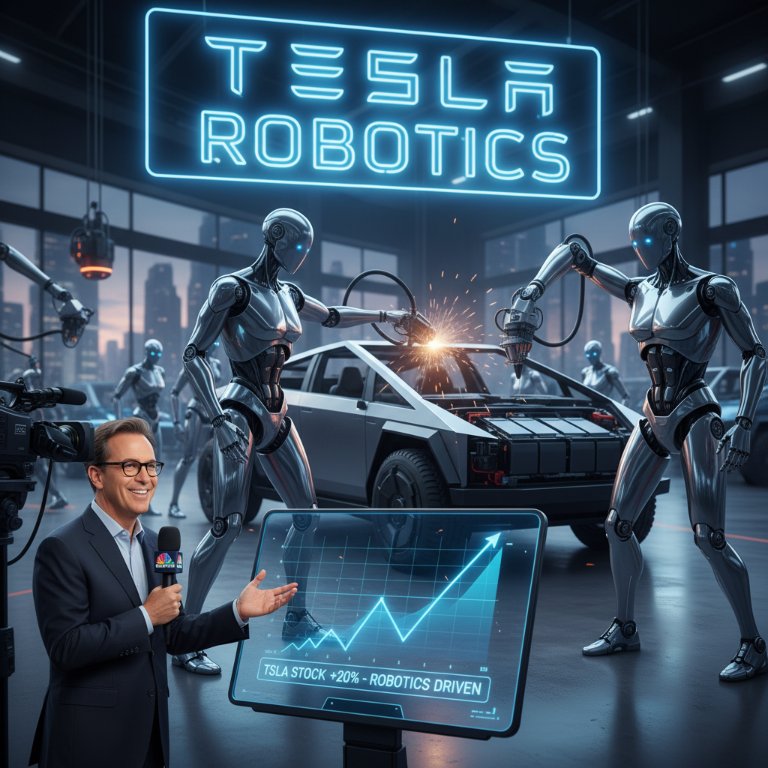
Wall Street has a new perspective on an old titan. Veteran analyst Jim Cramer recently delivered a bombshell assessment: Tesla should no longer be viewed merely as a car company, but rather as a robotics company. This isn't just a semantic shift; it's a profound reclassification reflecting Tesla’s aggressive strategic pivot and substantial investments in artificial intelligence (AI) and advanced robotics.
For years, Tesla dominated headlines as the trailblazer of the electric vehicle (EV) revolution, challenging established automakers with its sleek designs and innovative battery technology. While its automotive division has seen fluctuating performance, even an "underwhelming" quarter, the underlying narrative has consistently pointed to a company with far broader ambitions. This reclassification by a prominent analyst like Cramer underscores a growing market recognition of Tesla's long-stated, but often underestimated, technological depth beyond just building cars.
Beyond the Automotive Mold: Cramer's Provocative Reclassification
Cramer’s assertion stems from a clear-eyed look at where Tesla is channeling its capital and strategic focus. The company plans to pour over $20 billion into capital expenditures in 2026, primarily targeting AI, robotics, and self-driving infrastructure. This colossal investment, roughly double what Wall Street anticipated, signals a decisive shift. In fact, Tesla is reportedly discontinuing its premium Model S and Model X vehicles to repurpose those production lines for its Optimus humanoid robots, a bold move that further solidifies its commitment to a robotics-first future.
A Deep Dive into Tesla's Robotic Ambitions
Tesla's journey into robotics isn't nascent; it's a culmination of years of development across several key areas:
- Full Self-Driving (FSD): Tesla's FSD system, classified as SAE Level 2 ADAS (Advanced Driver-Assistance System) as of January 2024, has been accumulating billions of miles of real-world driving data. This data is critical for training the neural networks that power its autonomous driving capabilities, allowing vehicles to make increasingly human-like decisions. While it still requires human supervision and has faced criticism, FSD continues to evolve, with recent updates showing improved navigation in complex environments like parking garages and city streets. The company has even established local AI training centers in China to optimize its assisted driving systems for unique local conditions.
- Optimus Humanoid Robot: Perhaps the most visible representation of Tesla's robotics pivot, Optimus is a general-purpose robotic humanoid under active development. Recent demonstrations highlight significant advancements in bipedal locomotion, balance, and hand dexterity, with Optimus V2 hands capable of intricate tasks. Tesla aims for large-scale production, with plans for a dedicated Optimus factory and an ambitious target of 1 million units annually by late 2026. While Elon Musk recently admitted that Optimus robots are not yet doing "useful work" in factories in a material way, the Gen 3 version, designed for mass production, is slated for unveiling in Q1 2026, with production anticipated to begin before the end of 2026.
- Gigafactory Automation: Tesla's manufacturing facilities have long embraced automation. While early attempts at "alien dreadnought" levels of automation faced "production hell" and a reintroduction of human labor for some complex tasks, the company continues to push boundaries. Gigafactory Shanghai, for instance, boasts up to 95% automated production in some areas, leveraging a dense network of robotic arms for welding, assembly, and material transport. This internal expertise in robotics and AI-driven manufacturing provides a fertile testing ground and a competitive advantage for scaling future robotic endeavors.
Why This Matters:
This reclassification is far more than a stock analyst's musing; it’s a critical recalibration of how the market and public perceive one of the most influential companies of our era. Here’s why it matters:
- Valuation Rerating: Traditionally, automotive companies are valued on lower multiples than technology or robotics firms. Shifting the perception to a robotics company could unlock significantly higher valuations for Tesla, justifying its often-premium stock price. Investors are increasingly looking beyond EV sales to Tesla's more profitable AI-driven services.
- Attracting Top Talent: Branding itself as a leading robotics and AI company makes Tesla a magnet for the world's best engineers and researchers in these competitive fields, crucial for accelerating its ambitious projects like Optimus and Cybercab.
- Competitive Landscape: Tesla's true competitors may no longer be just traditional automakers or other EV startups. Instead, it could increasingly find itself vying with tech giants like Google's Waymo in autonomous driving, or specialized robotics firms in the humanoid space. Tesla has the unique advantage of vast real-world driving data to train its AI, a resource other robot makers lack.
- Future Revenue Streams: As traditional EV manufacturing reaches maturity, Tesla is strategically positioning itself for recurring revenue from AI-driven and mobility-as-a-service (MaaS) products, such as its nascent robotaxi fleet (Cybercab) and potential Optimus rentals or sales.
- Industry Disruption: This pivot signals a blurring of lines between industries. Tesla isn't just making cars; it's developing foundational AI and robotics technology that could revolutionize manufacturing, logistics, and even daily life, much like major tech companies have done with software and internet services. This broad realignment of its core business beyond its legacy premium EV lineup marks a significant evolution.
Tesla's evolution into a robotics and AI powerhouse is an aggressive, high-stakes gamble. While the automotive sector grapples with thinner margins and fierce competition, the potential rewards in AI and robotics are staggering. This shift isn't without its challenges, including significant capital expenditure and the need for flawless execution and regulatory approvals for robotaxis. However, for savvy investors and industry observers, Cramer's pronouncement serves as a potent reminder: underestimating Tesla's broader technological vision would be a profound mistake. The company is charting a course not just for the future of transportation, but for the very definition of a diversified, AI-powered enterprise.