Cracks in the Empire: Tesla's Q1 Delivery Miss Signals Deeper Challenges
For a company that has consistently defied expectations and redefined the automotive landscape, Tesla's latest vehicle delivery report for Q1 2026 mar...
Editorial Team
World Of EV
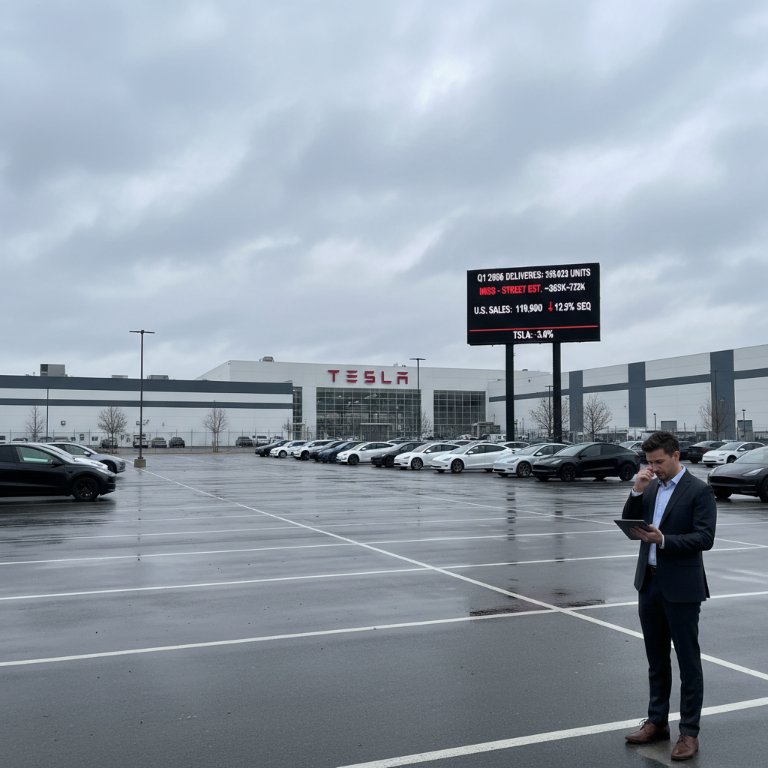
For a company that has consistently defied expectations and redefined the automotive landscape, Tesla's latest vehicle delivery report for Q1 2026 marks a concerning trend rather than an isolated misstep. The EV giant reported 358,023 deliveries, falling notably short of analyst consensus estimates that hovered between 365,645 and 372,160 units. This isn't just a slight underperformance; it represents the second consecutive quarter Tesla has missed its projections, signaling potential headwinds that could reshape the narrative around the once-unassailable EV leader.
Weakness on Home Soil: A Troubling U.S. Trend
The delivery figures reveal particularly soft performance in Tesla's critical home market. U.S. sales clocked in at 119,900 vehicles, a significant 12.5% sequential decline. Even more alarming is the March U.S. sales figure of 41,300 units, which represents the sixth consecutive monthly year-over-year decline for Tesla in the United States. This sustained contraction in its foundational market raises serious questions about demand saturation, intensifying competition, or perhaps a waning appeal of its current model lineup.
Production Outpaces Demand, Raising Inventory Concerns
While deliveries faltered, Tesla's production numbers tell another part of the story, albeit a worrying one. The company produced over 408,000 vehicles during the quarter, creating a substantial gap of approximately 50,000 units between production and deliveries. For years, Tesla's narrative was one of struggling to produce enough vehicles to meet insatiable demand. This growing discrepancy suggests a fundamental shift, where the challenge is no longer just manufacturing capacity, but rather finding buyers for the vehicles rolling off the assembly line. This inventory build-up could exert downward pressure on pricing and margins in subsequent quarters.
Why This Matters:
This delivery miss is far more than just a statistical anomaly; it's a critical indicator for several segments of the market:
- For Tesla Itself: The consecutive misses and the clear softening in the U.S. market suggest that Tesla's growth story is facing its most significant challenge yet. The company's aging Model 3 and Model Y, while still strong sellers, are encountering increasingly sophisticated and compelling competition from traditional automakers and emerging EV players globally. Without a new mass-market model on the immediate horizon—the Cybertruck, while eye-catching, remains a niche product—Tesla's ability to reignite demand through innovation and aggressive pricing strategies is under intense scrutiny. This could signal a pivot from aggressive growth to a focus on profitability and market share defense.
- For the Broader EV Industry: Is this a 'Tesla problem' or an 'EV problem'? While some may point to a general softening in EV demand, Tesla's unique market position and historically higher price points often insulate it from broader market fluctuations. Its struggles could indicate that even premium EV offerings are reaching a saturation point in key markets, or more likely, that the competitive landscape has fundamentally shifted. Companies like BYD, with their aggressive global expansion and diverse product portfolio, stand to gain significant ground if Tesla's momentum continues to falter. Traditional OEMs, having invested heavily in dedicated EV platforms, will see this as an opportunity to close the perception gap.
- For Prospective EV Buyers and Investors: For buyers, sustained delivery misses could translate into more aggressive incentives or price adjustments from Tesla as it seeks to clear inventory. For investors, the immediate 3% decline in Tesla's stock following the announcement underscores market anxiety. The upcoming Q1 2026 financial results, slated for April 22, 2026, will be critical. Investors will be scrutinizing gross margins, average selling prices, and executive commentary for any signs of a coherent strategy to address these demand issues.
The road ahead for Tesla appears increasingly complex. The era of near-unfettered growth driven by novelty and limited competition seems to be drawing to a close. The coming quarters will undoubtedly test Tesla's resilience and its ability to adapt to a rapidly maturing and hyper-competitive global EV market.