China's Spring Festival 'Stress Test' Reveals EV Infrastructure Gaps, Ignites Innovative Automaker Responses
China's Spring Festival holiday, a period of unprecedented mass migration, has once again served as a critical 'stress test' for the nation's rapidly ...
Editorial Team
World Of EV
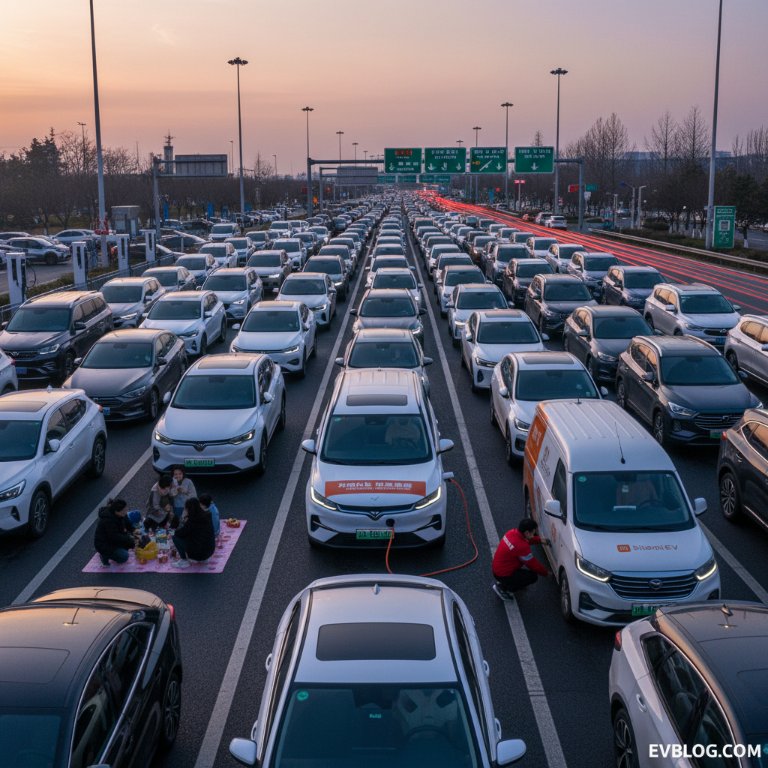
China's Spring Festival holiday, a period of unprecedented mass migration, has once again served as a critical 'stress test' for the nation's rapidly expanding New Energy Vehicle (NEV) ecosystem. While showcasing the incredible adoption rate of electric vehicles across the country, the recent travel surge also vividly exposed persistent infrastructure bottlenecks, particularly for long-distance journeys. Automakers, however, are not standing idle; their proactive and innovative responses are setting new benchmarks for customer support and defining the next frontier of EV ownership.
Unprecedented Demand Strains the Grid
The sheer scale of EV adoption became undeniably clear during the holiday period. Daily charging volume was projected to soar above 34 million kWh, marking a substantial 17% year-on-year increase. More tellingly, highway charging volume was anticipated to surge by over 23%. This data isn't just a testament to the growing number of EVs on the road; it underscores the escalating pressure on existing charging infrastructure, especially outside major urban hubs where fast chargers can be sparse and queues lengthy. For many EV owners accustomed to convenient home or city charging, extended highway travel during peak periods remains a significant source of range and charging anxiety, a challenge that companies like Tesla and BYD have been working to mitigate with their own expansive fast-charging networks, but one that still persists across the broader market.
XPENG Pioneers Mobile Energy Solutions
In a standout move, XPENG demonstrated remarkable foresight by deploying its X9 multi-purpose vehicles as mobile charging stations. These innovative X9s provided emergency vehicle-to-vehicle (V2V) charging, offering crucial lifelines to stranded drivers. This direct assistance, delivering approximately 50 kilometers of range per hour, is more than just a roadside rescue; it's a practical, on-the-go solution that directly addresses the immediate anxieties of long-distance EV travel. While not a permanent replacement for fixed charging infrastructure, XPENG's initiative highlights a strategic understanding of customer pain points and a willingness to leverage its own products creatively to enhance the ownership experience.
Xiaomi EV Bets on Service to Build Trust
Meanwhile, newcomer Xiaomi EV, fresh off its highly anticipated SU7 launch, is prioritizing service guarantees to cultivate trust and alleviate 'long-distance reliability anxiety' among its new customer base. The company's focus on comprehensive roadside rescue and on-site tire replacement during the Spring Festival is a strategic move in a highly competitive market. For a brand venturing into automotive, the perceived reliability and support infrastructure are as critical as the vehicle's features and performance. This proactive service approach mirrors the luxury segment's emphasis on customer care, sending a clear signal that Xiaomi EV understands the holistic ownership experience is paramount, especially when challenging established incumbents.
Why This Matters:
This Spring Festival 'stress test' provides invaluable insights into the maturation of China's EV market. The dramatic surge in charging demand clearly signals that while vehicle adoption is booming, the charging infrastructure, particularly for peak holiday travel, still lags. This disparity creates a critical challenge but also a fertile ground for innovation. Automakers like XPENG and Xiaomi EV are the clear winners here, distinguishing themselves not just by building excellent vehicles, but by taking proactive steps to alleviate customer pain points. XPENG's V2V charging solution showcases the potential for vehicles to become part of the solution, signaling a future where distributed energy resources play a more significant role in grid resilience. Xiaomi EV's service-first approach underscores that in a saturated market, brand loyalty will increasingly hinge on comprehensive support and a hassle-free ownership experience. This isn't a 'do-or-die' moment in the traditional sense, but it is a critical juncture. Automakers who fail to acknowledge and adapt to these evolving infrastructure and service demands risk losing market share and eroding customer trust in China's fiercely competitive and rapidly evolving EV landscape. For the industry as a whole, these events signal a necessary pivot from purely product-centric development to a more holistic ecosystem approach, where vehicle and infrastructure are intrinsically linked.
Conclusion:
The Spring Festival holiday served as a powerful reminder that the journey towards mass EV adoption extends far beyond the vehicle itself. The challenges encountered, particularly around charging infrastructure during peak travel, are not roadblocks but catalysts for ingenuity. The innovative responses from companies like XPENG and Xiaomi EV demonstrate a crucial understanding that the future of electric mobility hinges on robust service networks and creative solutions that address real-world owner anxieties. As China continues to lead the global EV revolution, these learnings will undoubtedly shape the development of smarter infrastructure and more customer-centric services worldwide.