China Unveils 500 Wh/kg "Super Battery," Poised to Shatter EV Range Barriers by 2026
In a development set to fundamentally reshape the electric vehicle landscape, Chinese scientists have announced a groundbreaking battery technology bo...
Editorial Team
World Of EV
A New Benchmark in Energy Density
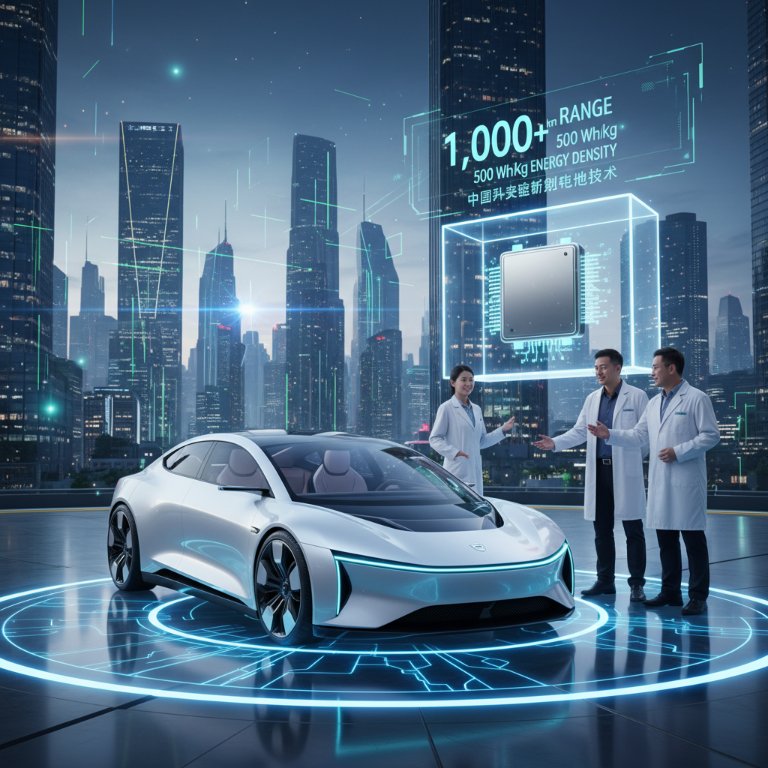
In a development set to fundamentally reshape the electric vehicle landscape, Chinese scientists have announced a groundbreaking battery technology boasting an astonishing energy density of 500 Wh/kg. This ultra-high-energy-density battery, a collaborative effort led by Academician Chen Jun of the Chinese Academy of Sciences and China Automotive New Energy Battery Technology Co Ltd (FAW's battery unit), promises to propel EVs past the critical 1,000 km (620 miles) CLTC driving range on a single charge, addressing two of the most persistent hurdles to widespread EV adoption: range anxiety and diminished cold-weather performance.
This isn't just an incremental improvement; it's a monumental leap forward, echoing the profound impact that innovations like BYD's Blade Battery had on LFP chemistry's viability, or Tesla's continuous push with its 4680 cells. For years, the industry has chased higher energy densities to achieve true long-distance electric mobility without compromise, and China now appears to be delivering a solution that pushes the boundaries of current practical applications.
The announced 500 Wh/kg energy density marks a significant milestone, projecting a future where electric vehicles can genuinely rival, if not surpass, the convenience of gasoline-powered cars in terms of range. This advancement is specifically engineered to enable:
- Over 1,000 km (620 miles) CLTC driving range on a single charge.
- Enhanced cold-weather performance, a long-standing Achilles' heel for existing EV batteries.
This new technology effectively propels conventional lithium-ion battery capabilities into territory previously only theorized for advanced, often costly, solid-state designs. The implications for vehicle weight, packaging, and overall efficiency are profound, potentially allowing for smaller, lighter battery packs that still deliver exceptional range.
Redefining EV Performance Against Industry Leaders
To understand the magnitude of this breakthrough, consider the current state of the art. Today's leading EV battery cells from manufacturers like Tesla and BYD, while impressive, operate at significantly lower energy densities. Tesla's highly publicized 4680 cells typically offer an energy density in the range of 241 to 296 Wh/kg [2, 8, 13, 10]. Similarly, BYD's current generation Blade batteries are around 160-168 Wh/kg, with the upcoming Blade 2.0 projected to reach 190-210 Wh/kg [1, 2, 3, 4, 5, 6]. Mainstream NMC and NCA batteries generally fall within the 150-300 Wh/kg range, with some advanced systems pushing towards 350 Wh/kg [9, 11, 12, 15].
The Chinese team's 500 Wh/kg battery thus nearly doubles the energy density of many cutting-edge production cells and positions itself at the upper end of what solid-state battery technology is projected to achieve in the coming years (typically 300-500 Wh/kg) [9, 12]. This isn't just about longer range; it implies substantially lighter battery packs for a given capacity, leading to more efficient vehicles, better handling, and potentially more interior space.
The Road to Mass Production
Critically, this isn't merely a laboratory curiosity. The announcement includes a firm timeline for mass production by the end of 2026. The involvement of China Automotive New Energy Battery Technology Co Ltd, FAW's dedicated battery unit, underscores a clear path from research to commercial application. This commitment from a major automotive player suggests robust development and a strategic intent to integrate this technology into vehicles swiftly, potentially giving Chinese automakers a significant competitive advantage.
Why This Matters:
This announcement is nothing short of a paradigm shift for the electric vehicle industry, with far-reaching consequences across the globe.
- For Consumers: This battery could effectively eliminate range anxiety for the vast majority of drivers. Imagine owning an EV that reliably offers over 1,000 km of real-world range, performs robustly in freezing temperatures, and requires charging as infrequently as a conventional car needs refueling on long trips. This fundamentally changes the proposition of EV ownership, making it a viable and attractive option for even the most hesitant buyers.
- For the Automotive Industry: The pressure on global battery developers and automakers outside of China will intensify dramatically. Companies like Panasonic, LG Energy Solution, Samsung SDI, and even CATL and CALB will be forced to accelerate their own high-density battery roadmaps. This breakthrough also signals a potential shift in EV design philosophies, allowing engineers greater flexibility in vehicle architecture, weight distribution, and overall performance. Automakers lagging in battery development risk falling significantly behind in the race for market share.
- For China's Global Standing: This solidifies China's already dominant position in the EV battery sector. By not only leading in manufacturing volume but also pushing the frontiers of technological innovation, China is establishing itself as the undisputed powerhouse of future electric mobility, potentially influencing global supply chains and technological standards.
- Potential Challenges: While the promise is immense, the industry will keenly watch for details on production costs, long-term durability, and safety protocols at such high energy densities. Scaling production of a revolutionary technology by late 2026 is an ambitious goal, and real-world performance will be the ultimate arbiter of its success.
This development from Chinese scientists and FAW's battery arm is more than just another battery announcement; it's a declaration of intent. With mass production targeted for late 2026, the era of 1,000 km-plus EVs is not a distant dream, but a rapidly approaching reality that will redefine expectations for electric mobility worldwide.