Beyond Expectations: Rivian's Q1 Triumph Forged with $1.25B Uber Robotaxi Vision
Rivian Automotive is not just exceeding expectations; it's aggressively charting a bold new future. The EV manufacturer delivered a robust 10,365 vehi...
Editorial Team
World Of EV
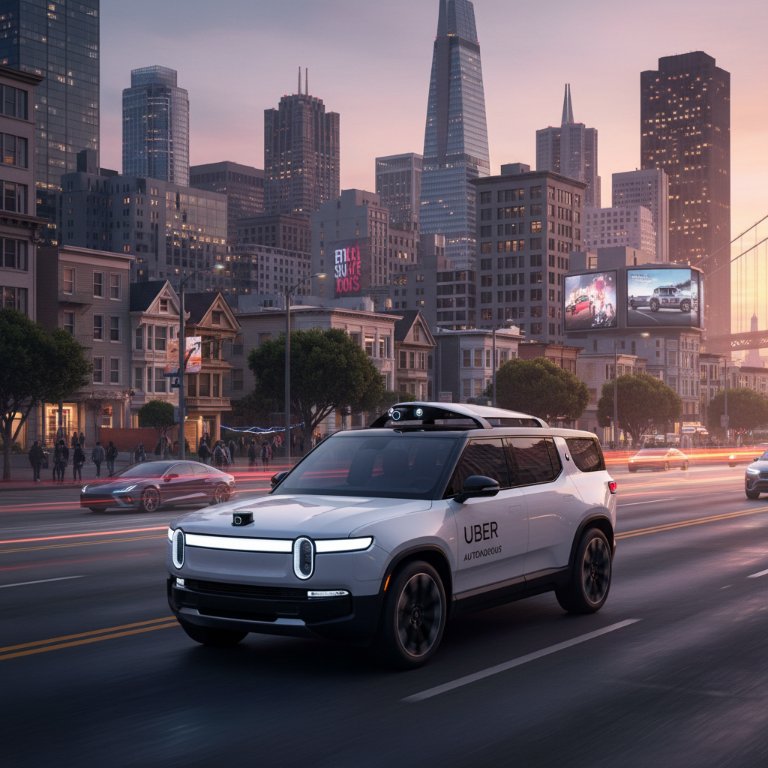
Rivian Automotive is not just exceeding expectations; it's aggressively charting a bold new future. The EV manufacturer delivered a robust 10,365 vehicles in the first quarter of 2026, handily surpassing analyst forecasts and signaling stabilizing demand for its acclaimed R1S SUV and R1T pickup. But while strong deliveries offer immediate reassurance, it's the concurrent announcement of a monumental long-term partnership with ride-sharing titan Uber that truly positions Rivian as a formidable, diversified force in the evolving mobility landscape. This strategic alliance, centered on deploying autonomous R2 SUVs as robotaxis, marks a pivotal moment for Rivian, moving beyond its premium adventure vehicle niche into the high-stakes world of autonomous ride-hailing.
Q1 Deliveries Signal Market Strength
Rivian’s latest delivery report is a clear indicator of growing operational maturity and market acceptance for its current R1 platform. The 10,365 vehicles delivered in Q1 2026 not only blew past the anticipated 9,678 units but also represented a significant 20% year-over-year increase compared to the same period last year. This robust performance is crucial context, demonstrating Rivian's ability to consistently ramp up production and meet customer demand after earlier struggles to scale its manufacturing operations. It underscores that the R1S and R1T, despite their premium price point, continue to attract a dedicated customer base, valuing their unique blend of performance, utility, and off-road capability. This sustained demand is a testament to the quality and appeal of Rivian's initial offerings in a fiercely competitive EV market.
Rivian's Robotaxi Ambitions Accelerate with Uber
While Q1 deliveries reinforce current market success, the strategic alliance with Uber fundamentally reshapes Rivian's long-term trajectory. Uber is set to invest up to an astonishing $1.25 billion into Rivian, specifically earmarking these funds for the development and deployment of a fully autonomous fleet of Rivian R2 SUVs as robotaxis. This ambitious collaboration will kick off with an initial $300 million investment from Uber, with deployment slated to begin as early as 2028. The initial focus for these self-driving R2 robotaxis will be high-demand corridors, specifically targeting routes between San Francisco and Miami. This isn't merely a vehicle supply deal; it's a deep-seated partnership aiming to integrate Rivian's hardware and autonomous capabilities with Uber's vast ride-hailing network.
- Uber's Investment: Up to $1.25 billion commitment from Uber, with an initial $300 million to accelerate development.
- Vehicle Platform: Rivian's forthcoming R2 SUV, designed for higher volume and lower cost than the current R1 platform.
- Deployment Timeline: Robotaxi operations expected to commence in 2028.
- Geographic Focus: Initial deployments planned for the San Francisco to Miami corridor.
- Goal: Build toward a fully autonomous fleet, signaling Uber's renewed and significant commitment to self-driving technology after previously divesting its ATG division.
Why This Matters:
This dual announcement—strong Q1 deliveries combined with the transformative Uber partnership—is nothing short of a game-changer for Rivian, offering profound implications for its financial stability, product strategy, and future market position.
De-Risking the R2 Launch and Securing Capital: The Uber investment of up to $1.25 billion injects substantial capital into Rivian, a company that has historically burned through considerable cash as it scaled production. This capital infusion arrives at a critical juncture, providing a robust financial cushion and significantly de-risking the upcoming R2 platform launch. The R2, designed to be a more accessible, lower-cost model than the R1, is pivotal for Rivian to expand its market share and achieve profitability. A guaranteed high-volume customer like Uber for the R2 provides a clear path to economies of scale and accelerates its path to production.
Strategic Entry into the Robotaxi Arena: This partnership immediately propels Rivian into the forefront of the burgeoning, yet highly competitive, autonomous ride-hailing market. While companies like Waymo and Cruise have pioneered this space, and Tesla continues to advance its FSD capabilities, Rivian now has a direct, massive avenue for deployment. Uber, having previously struggled with its own autonomous ambitions (selling its ATG division to Aurora Innovation in 2020), now gains a dedicated hardware partner with a compelling, purpose-built EV platform. This allows Rivian to diversify beyond consumer sales, creating a new, potentially massive revenue stream and validating its autonomous driving technology on a grand scale.
Validation and Market Confidence: The sheer scale of Uber's investment and its long-term commitment to the R2 robotaxi platform serves as an enormous vote of confidence in Rivian's technology, manufacturing capabilities, and strategic vision. This external validation from an industry giant like Uber will undoubtedly bolster investor confidence and further solidify Rivian's standing as a serious player, not just in EV manufacturing, but in the future of mobility. It signals to the broader market that Rivian is more than just a niche manufacturer of premium trucks and SUVs; it's an integrated mobility solution provider.
Who Wins? Rivian wins by securing critical funding, a massive customer for its R2 platform, and a direct path into the robotaxi market. Uber wins by securing a dedicated supply of purpose-built autonomous EVs and a strategic partner to re-enter and potentially dominate the autonomous ride-hailing space without the massive R&D overhead of developing its own vehicles from scratch. Consumers ultimately win through the potential for more affordable, efficient, and widespread autonomous mobility options.
What This Signals: This deal signals a maturing EV landscape where partnerships are crucial for accelerating innovation and scaling new technologies. It highlights the growing convergence of EV manufacturing, autonomous driving, and ride-sharing services, pointing towards a future where vehicle ownership models may shift dramatically. For Rivian, this is not a "do-or-die" moment, but rather a monumental leap forward, transitioning it from a promising startup to a formidable contender with a diversified strategy.
Rivian's first-quarter performance, highlighted by strong deliveries of its R1S and R1T models, provides a solid foundation, but it is the transformative partnership with Uber that truly defines this period. By leveraging its R2 platform for autonomous robotaxis, Rivian is not just securing significant capital; it's strategically positioning itself at the confluence of EV manufacturing, autonomy, and ride-sharing. This bold move promises to accelerate Rivian's growth trajectory and cement its role as a key innovator in the rapidly evolving world of electric and autonomous mobility.