ARAI vs. Reality: An MG Windsor EV Pro Road Trip Unpacks Range Truths and Charging Woes
The dream of seamless, long-distance electric vehicle (EV) travel often confronts a stark reality, as an MG Windsor EV Pro owner recently discovered o...
Editorial Team
World Of EV
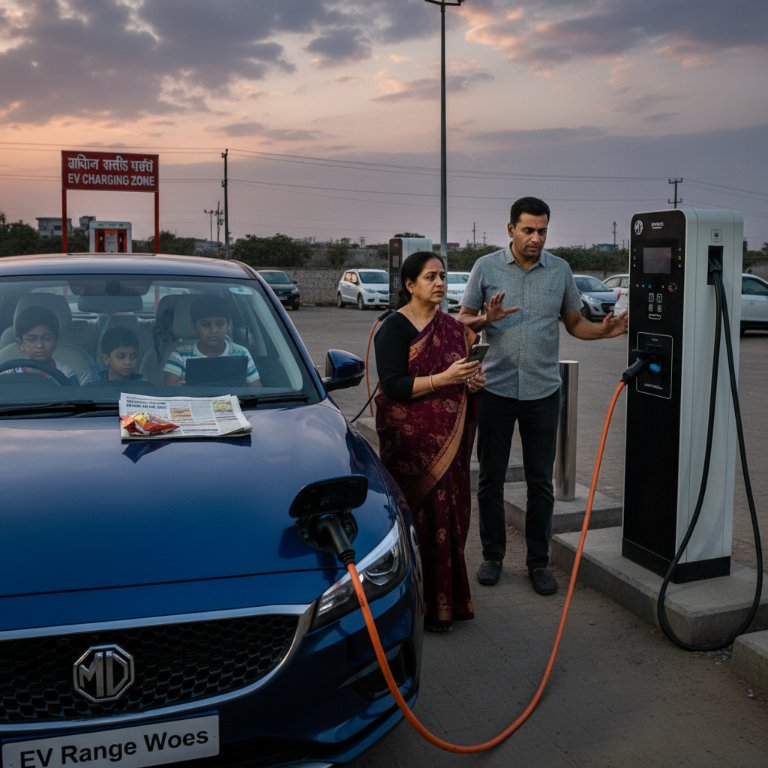
The dream of seamless, long-distance electric vehicle (EV) travel often confronts a stark reality, as an MG Windsor EV Pro owner recently discovered on a journey from Noida to Jaipur. While manufacturers tout impressive Automotive Research Association of India (ARAI) certified ranges, real-world conditions continue to challenge consumer expectations and expose the persistent issue of 'range anxiety.'
Kalpana Sharma's experience with her MG Windsor EV Pro highlights a crucial learning curve for many new EV adopters. Her family embarked on a 298km road trip, confident in the car's 449km ARAI-certified range, which theoretically allowed for the journey without a charging stop. This expectation, common among prospective EV buyers, quickly dissipated as the vehicle's battery depleted faster than anticipated under highway driving conditions. The discrepancy between ARAI figures and actual performance is a well-documented industry challenge, with real-world ranges often falling 20-40% below certified numbers, particularly during highway use.
The Unveiling of Real-World Range on the Highway
The Sharma family's trip from Noida to Jaipur, covering an actual distance of 298km, starkly contrasted with the MG Windsor EV Pro's 449km ARAI range. Their initial plan to complete the journey without a charging stop quickly proved optimistic. EVs, including the MG Windsor EV Pro, tend to consume more energy at consistent high speeds on highways compared to city driving, where regenerative braking opportunities are abundant.
ARAI vs. Actual: ARAI range figures are generated under controlled, standardized laboratory conditions, which often do not account for real-world variables like consistent high speeds, terrain, passenger load, or the use of climate control.
Highway Efficiency: Sustained highway speeds significantly impact an EV's range, as there are fewer opportunities for regenerative braking, which recharges the battery during deceleration.
Navigating India's Evolving Charging Infrastructure
The journey also brought to light the current state of public charging infrastructure in India. The Sharma family encountered common pain points, including the necessity to download new, often brand-specific, applications for different charging networks and an unexpected power outage that disrupted their charging session. This fragmented and sometimes unreliable charging ecosystem remains a significant hurdle for widespread EV adoption in India.
App Overload: The lack of a unified payment and access system for public charging stations forces users to juggle multiple apps, creating unnecessary friction.
Reliability Concerns: Power outages and technical glitches at charging stations undermine consumer confidence and exacerbate range anxiety.
Uneven Distribution: While the number of charging stations is growing, many are concentrated in urban centers, leaving highways and rural areas with inadequate coverage.
Mastering the EV Road Trip: Lessons Learned
Upon returning home, the Sharma family adapted their approach to EV ownership, gaining valuable insights into maximizing range and mitigating anxiety. Their learnings underscore the importance of driver education and proactive planning in the EV era.
Efficient Driving: Adopting a more conservative and efficient driving style, avoiding aggressive acceleration and maintaining steady speeds, significantly extends range.
Proactive Charging: Stopping for a charge earlier in the journey, for instance, when the battery reaches 70%, rather than pushing it to lower levels, dramatically reduces range anxiety. This strategy allows for flexibility and accounts for potential charging infrastructure issues.
City Driving Advantage: The family observed that EVs lose charge much slower in city driving due to the frequent use of regenerative braking, which recovers energy during stop-and-go traffic.
Why This Matters:
This individual account from an MG Windsor EV Pro owner is far more than a personal anecdote; it is a critical signal to the entire EV ecosystem. For automakers like MG, it underscores the urgent need for more accurate, real-world range predictors in vehicle infotainment systems. While ARAI figures provide a baseline, consumers need transparent expectations that reflect diverse driving conditions. Companies that bridge this gap with intelligent navigation systems that accurately factor in topography, driving style, and real-time charging availability will gain a significant competitive edge.
For charging infrastructure providers, the fragmented app landscape and reliability issues are red flags. The future of EV adoption hinges on a seamless, consistent, and dependable charging experience. A unified payment system, akin to traditional fuel stations, and robust grid infrastructure, capable of handling growing demand without outages, are no longer luxuries but necessities.
Crucially, for the savvy EV enthusiast and prospective buyer, this experience highlights that successful EV ownership involves a shift in mindset. It's not just about the car's capabilities but also about understanding its limitations in specific scenarios and adapting driving and charging habits accordingly. The 'why' behind range anxiety isn't always battery size; it's often the unpredictable interplay of real-world driving, optimistic range estimates, and a still-maturing charging network. This situation signals a 'do-or-die' moment for the industry to align advertised capabilities with user experience, or risk stifling the broader EV revolution. Consumers win when transparency and reliability become paramount; the entire industry benefits from a more informed and satisfied user base.
Conclusion
The journey of Kalpana Sharma's family serves as a valuable case study, emphasizing that while EVs offer immense potential, their widespread adoption for long-distance travel still requires a collaborative evolution of vehicle technology, infrastructure, and consumer education. The key takeaway is clear: understanding the nuances of real-world EV performance and proactively planning for charging stops transforms potential range anxiety into confident, enjoyable electric road trips. As the EV market matures, bridging the gap between theoretical capabilities and practical realities will be crucial for accelerating the electric future.